Monday, September 24, 2012

Greek baby names and generations


The Telegraph writes about the new love for Greek baby names among celebrities:

[Robin] Williams had promised his daughter wouldn’t have a “mad celebrity baby name” but something “very solid, old-school”. Theodora is certainly that – nearly 2,000 years old, to be precise.
Of Greek origin, meaning “God’s gift” – from theos (God) and doron (gift) – Teddy has it in common with Theodora Richards, daughter of Rolling Stone Keith and model Patti Hansen, who made up for such a sound choice by then landing her with the middle name Dupree.
Picking the right name can be tricky, and Mr and Mrs Williams aren’t the first high-profile couple to turn to ancient Greece for inspiration. First, there was Zachary, the son of Elton John and David Furnish, whose name comes from Zacharias, another Greek word meaning “remembrance of the Lord”. Kourtney Kardashian, the younger sister of American reality TV star Kim, named her daughter Penelope (from penelops, a predatory bird); while actress Hilary Duff’s toddler is called Luca, from the Greek Loukas, or “man from Lucania”.

I was reminded of a book I recently came across called Generations: The History of America's Future, 1584 to 2069. It argues that history is driven by a repeating cycle of generations: idealist, reactive, civic, and adaptive. In the most recent iteration of the cycle, the boomers are "idealist", Generation X is "reactive", Gen Y is "civic", and the generation to come will be "adaptive". 

I'd be willing to bet that a traditional baby name was Williams' wife's idea -- she's a "reactive" Gen Xer, while he's an "idealist" baby boomer. 

Given my profession, I'm hoping the next generation of "adaptive" college students aren't so focused on consensus-building that they let classroom discussions die, or write dull papers (she said ironically).

Pin It

Sunday, September 23, 2012

German debts to Greece?

from salon.com:
Beginning in 1942 the German occupiers demanded that Greece pay, monthly, the cost of being occupied. Over the past two decades various Greek governments have raised the subject of that theft, which amounts to $14 billion in today’s dollars (without interest). Germany has dismissed the idea that it owes Greece anything. There is a certain short-sightedness in the German insistence that debts must always, always be repaid.
Pin It

Thursday, September 20, 2012

The klismos chair, a brief history

I've been looking at ancient Greek furniture lately, and I was particularly drawn to the klismos, a chair with a sloped back and four curved legs.

image credit
For one thing, I remember translating klismos as "easy chair" in my first Greek reading class. Seeing what an austere, if graceful, thing it is, I'm amused that we talked about them as though they were La-z-boy recliners. I also love the idea that they're still part of modern furniture design. It's reassuring to classicists whenever we find a bit of the ancient world in an unexpectedly modern setting.

Recreation of a Greek klismos (credit)
Klismoi first appear in Homer and later in classical art like the vase-painting above. The curved back provides support and the curved legs are very stable, although they may spread out and break if too much weight is put on them.

Klismos chairs were revived in the eighteenth-century neoclassical period, first as props for historically-themed paintings and later as everyday furniture.

Neoclassical chair based on klismos (credit)
 Amazon lists several modern klismos chairs (shockingly expensive). "Design by Todd" considers how they could be used in a modern house, ultimately concluding that they are best employed as a "statement piece" or a "sculpture" -- too deep to sit in comfortably.


Oh well, it's better than a backless stool, right?
Pin It

Tuesday, September 18, 2012

Birds do it, bees do it ...

Kohl container from Egypt

From Care2, a website on healthy and green living (strangely enough), comes this list of 22 unusual word origins:

7. DogI mentioned before that some etymologies are just plain baffling; dog is unquestionably one of those. The word dog was docga in Old English, but nobody can decide where it actually came from. The word hund (of Germanic origin, which became modern-day hound) was much more common, so it’s likely that dog/docgawas an informal or non-literary word… but how did it spring into existence? No one really knows for sure. 
8. ButterflyThere are several conflicting explanations for the origin of butterfly. It may come from a combination of Old English bēatan “to beat,” and flēoge “fly.” The first part of the word may instead come from butere, or “butter,” which may have originally referred only to yellow-colored butterflies. However, my favorite explanation of butterfly is that is could have come from the Middle Dutch word boterschijte, which referred to the fact that their excrement may look similar to butter: literally, “butter-shitter.” Think of that the next time you encounter a gorgeous butterfly!

10. AlcoholThe word alcohol came into English with the help of Latin, but it’s originally from the Spanish Arabic al-kuḥul, which means “the kohl” (kohl being a black powder that is used as eye makeup). Wait, what? Well, the process that is used to make kohl involves vaporizing and then cooling a solid substance, while the process of distilling alcohol is the same deal, but with a liquid. So, over the course of centuries, it began to mean an “essence obtained by distillation” and then finally “spirit of wine, ethanol.”
image credit 


Pin It

Good for them

Greek professors in border towns are moonlighting at Albanian schools:

The representatives from these seven universities that met with Albanis wanted to explore whether professors from Ioannina University -- and especially in the medical field -- would be interested in teaching in Tirana a few days a week. Other than a good supplementary salary, the offer also included travel expenses, a car service from the Greek-Albanian border into Tirana, as well as room and board.

Things are still wretched over there, but I'm still a little envious of a situation where professors are in actual demand. Pin It

Monday, September 10, 2012

Who doesn't love a little Latin prose humor?

"The Ides of March
Dear D-L-L,

I am studying Latin prose composition. I have been studying it. I shall be studying it. I shall be about to have been studying it ... you may expect to hear from me next, either whole and happy and free from conditions, or in fragments."

-Daddy-Long-Legs, by Jean Webster
Pin It

Saturday, September 8, 2012

Tying the knot

An article on the "Mother Nature Network"  recently discussed reef knots on the Mars rover , briefly mentioning their origins in Egypt and Greece. I needed an excuse to look at something pretty (it being rather grey and grim in my remote Midwestern locale), so ...

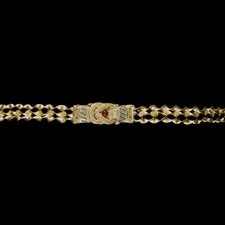
Googling the Greek name for it, "Herakles knot," brings up dozens of ancient necklaces and tiaras. It seems that the knot symbolized fertility and the marriage 'knot,' a meaning which probably grew  from its use in medicine and especially to tie women's belts.

Another symbolic knot, the proverbial "Gordian knot," was perhaps a "knot-cypher" that symbolized the "ineffable name of Dionysus." (Graves, The Greek Myths, 284) 

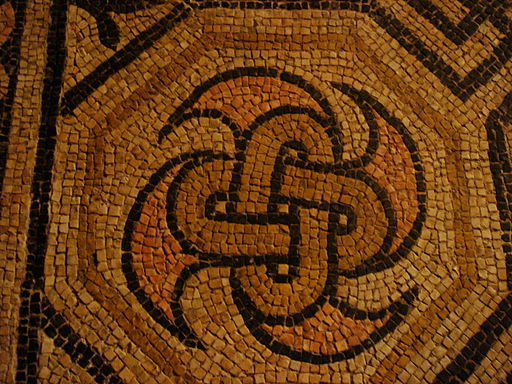
A bit of a tangent, but Celtic knotwork may have originated in the late Roman empire, where interlace floor mosaics are popular:

After all, what do we do as classicists but study beautiful and enduring things made from simple materials?
Pin It