Greek professors in border towns are moonlighting at Albanian schools:
The representatives from these seven universities that met with Albanis wanted to explore whether professors from Ioannina University -- and especially in the medical field -- would be interested in teaching in Tirana a few days a week. Other than a good supplementary salary, the offer also included travel expenses, a car service from the Greek-Albanian border into Tirana, as well as room and board.
Things are still wretched over there, but I'm still a little envious of a situation where professors are in actual demand.
Pin It
Tuesday, September 18, 2012

Monday, September 10, 2012
Who doesn't love a little Latin prose humor?
"The Ides of March
Dear D-L-L,
I am studying Latin prose composition. I have been studying it. I shall be studying it. I shall be about to have been studying it ... you may expect to hear from me next, either whole and happy and free from conditions, or in fragments."
-Daddy-Long-Legs, by Jean Webster
Pin It
Saturday, September 8, 2012
Tying the knot
An article on the "Mother Nature Network" recently discussed reef knots on the Mars rover , briefly mentioning their origins in Egypt and Greece. I needed an excuse to look at something pretty (it being rather grey and grim in my remote Midwestern locale), so ...
Googling the Greek name for it, "Herakles knot," brings up dozens of ancient necklaces and tiaras. It seems that the knot symbolized fertility and the marriage 'knot,' a meaning which probably grew from its use in medicine and especially to tie women's belts.
_300_bC.jpg)
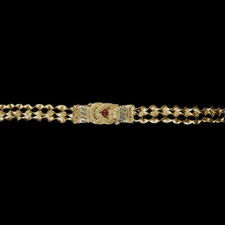
Another symbolic knot, the proverbial "Gordian knot," was perhaps a "knot-cypher" that symbolized the "ineffable name of Dionysus." (Graves, The Greek Myths, 284)
A bit of a tangent, but Celtic knotwork may have originated in the late Roman empire, where interlace floor mosaics are popular:

_300_bC.jpg)
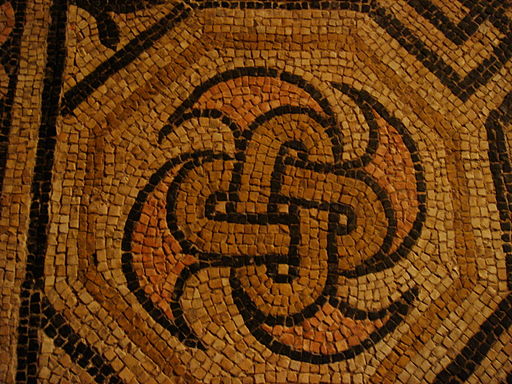
After all, what do we do as classicists but study beautiful and enduring things made from simple materials?
Pin It
Sunday, September 2, 2012
It's called panegyric, people.
 |
| Bust once thought to show Poppaea Sabina |
I might be missing something about the new poem praising Poppaea Sabina, second wife of Nero. MSNBC implies that its sentimental theme shows a "very different side to this ancient couple." Nero, of course, is said to have murdered his first wife Octavia to marry Poppaea, and to then caused Poppaea to miscarry by kicking her in the stomach.
MSNBC also ponders why the poem "was written nearly 200 years after Nero died … why [would] someone so far away from Rome bother composing or copying it at such a late date." The article explains some possibilities below, such as a "deification poem" or a "poem of circumstance" comparing an Egyptian official and his dead wife to Nero and Poppaea.
That's all well and good, but this notion that the romantic relationship in the poems shows a "different side" of Nero is silly. Should the poet have represented Poppaea as trapped in a relationship with a crazed despot?
My spouse and I debate the point of classics education sometimes, but I hope we at least teach our students not to take everything they read at face value.

Thursday, August 30, 2012
Epic heroes and their stuff
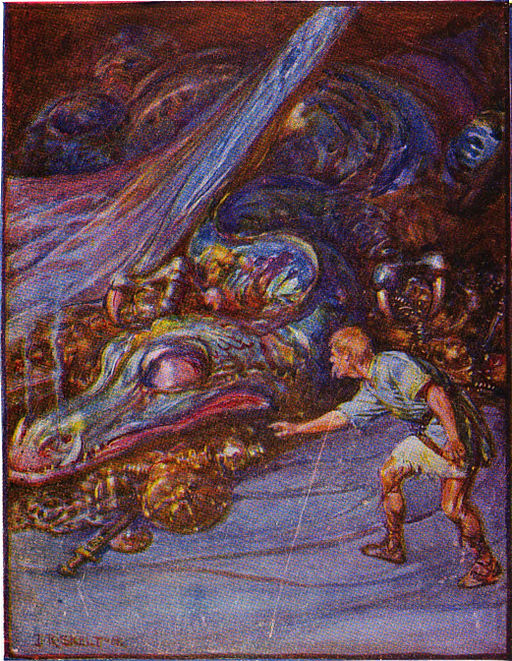 |
| The dragon's hoard from Beowulf |
I recently read From Villain to Hero: Odysseus in Ancient Thought, a book about Odysseus' role as a philosophical hero post-Homer. The philosophical schools that co-opted Odysseus as a spokesman, or at least an exemplar of their teaching, always had to deal with his love of stuff, his attachment to material gain. Plato, for example, shows Odysseus receiving a new life as a philosopher in the Myth of Er, in part so that he can circumvent the issue of the Homeric character's greed (49 and passim).
I thought this was rather unfair of the philosophers (she said anachronistically). I've always understood timē (pronounced teemai), the desire to get stuff as a sign of status, to be a widespread (and perfectly respectable) Homeric value. Epic heroes in other cultures do it too. Beowulf dies happy knowing that he's gained lots of gold for his people by slaying the dragon who was guarding it.
Margalit Finkelberg (Time and Arete in Homer, CQ 48:1 (1998) 14-28) is illuminating on this point. She argues that timē is an aristocratic value already outdated by the time our Iliad was composed. In speeches, the most flexible part of the poem, the egalitarian value of aretē is uppermost.
Poseidon's speech to the Greeks in Iliad 14 and the description of the Greek army at the beginning of Iliad 3 stress acting for the benefit of the community, the essence of aretē (27). Homeric performers in the eighth century and after praised aretē but preserved the role of timē because it was essential to the plot. After all, Achilles and Agamemnon didn't quarrel over who could benefit the community most.
As I read example after example of urban philosophers criticizing or ignoring Odysseus' love of profit, it occurred to me that city life doesn't exactly make poverty easier, but it makes the single-minded acquisition of wealth less necessary. Lots of smart and motivated people enjoy living in tiny apartments in New York who would need a lot more space and things to be happy where I live.

Friday, August 17, 2012
"Will our family ever desist from madness?"
 |
| From The Comic History of Rome |
I've been looking further into mothers in the ancient world. I remembered Cornelia Africana, mother of the Gracchi, from a passage in Wheelock's Latin. I can't find the page, but it's a simplified version of this:
Valerius Maximus 4.4:A companion matron who was staying with Cornelia, mother of the Gracchi, was showing off her jewels, the most beautiful of that period. Cornelia managed to prolong the conversation until her children got home from school. Then she said, "These are my jewels."
Cornelia's sons, Tiberius and Gaius Gracchus, served as tribunes in the late second century and were both assassinated, Tiberius for redistributing land among the plebeians and Gaius for granting citizenship to Italians living outside Rome.
Their mother, widowed young, was lionized for never remarrying, for directing her sons' education and for writing powerful letters to her sons that were later circulated as a collection. Only two fragments of survive today. I will quote the longer fragment, from a letter to her son Gaius when he was tribune:
“You will say that it is a beautiful thing to take on vengeance on enemies. To no one does this seem either greater or more beautiful than it does to me, but only if it is possible to pursue these aims without harming our country. But seeing as that cannot be done, our enemies will not perish for a long time and for many reasons, and they will be as they are now rather than have our country be destroyed and perish. . . . I would dare to take an oath solemnly, swearing that, except for those who have murdered Tiberius Gracchus, no enemy has foisted so much difficulty and so much distress upon me as you have because of the matters: you should have shouldered the responsibilities of all of those children whom I had in the past, and to make sure that I might have the least anxiety possible in my old age; and that, whatever you did, you would wish to please me most greatly; and that you would consider it sacrilegious to do anything of great significance contrary to my feelings, especially as I am someone with only a short portion of my life left. Cannot even that time span, as brief as it is, be of help in keeping you from opposing me and destroying our country? In the final analysis, what end will there be? When will our family stop behaving insanely? When will we cease insisting on troubles, both suffering and causing them? When will we begin to feel shame about disrupting and disturbing our country? But if this is altogether unable to take place, seek the office of tribune when I will be dead; as far as I am concerned, do what will please you, when I shall not perceive what you are doing. When I have died, you will sacrifice to me as a parent and call upon the god of your parent. At that time does it not shame you to seek prayers of those gods, whom you considered abandoned and deserted when they were alive and on hand? May Jupiter not for a single instant allow you to continue in these actions nor permit such madness to come into your mind. And if you persist, I fear that, by your own fault, you may incur such trouble for your entire life that at no time would you be able to make yourself happy.”
The letter is skillfully written and milks the rhetorical question to death in the best Roman fashion. But Judith Hallett (in Women Writing Latin) argues that Cornelia does not merely rival the rhetorical skills of male authors, but that her letter is a model of "maternal motivational speaking" that influenced Livy and Vergil:
Cornelia's letter to Gaius, which articulates Roman political values that include a concern for families and their emotional needs, is a radical document. Its author's priorities differ greatly from those inculcated by Roman patriarchal tradition, which pitted political against familial and emotional concerns. We should also note that ….. [t]he Roman literary figures and historical personages who gave voice to these priorities in the generations after Cornelia include men as well.
However difficult it is to reconstruct the historical Cornelia in detail, she must have been fierce and a little scary. I'm becoming more and more enamored of the Romans' lack of sentimentality, and their notion of the 'ideal mother' is no exception.

Wednesday, August 8, 2012
The Little Bears of Artemis

I intended this post to be about cultural attitudes toward motherhood in antiquity. With a new school year starting, I was remembering when I taught part-time (not by choice) and my troglodytic chair congratulated himself on how he was facilitating my 'work-life balance.' Yuck.
But while poking around I came across the delightful Cult of Artemis at Brauron. This is the cult of the arkteia, the 'bear-dance' performed by young Athenian girls as a rite of passage into womanhood. I enjoyed the Wikipedia article on it for the couple of WTF? moments it gave me.
Basically, girls between 5 and 10 would worship Artemis in a festival culminating in a wild dance in which the participants stripped. So, the first head-scratching moment comes when Wikipedia explain that this is part of the rigorous preparation for a young woman's first childbirth.
However, it seems that the dance associated the girls with Iphigeneia, who was to be sacrificed in atonement for the killing of a mother bear. She shed her robes in order to draw the viewers' pity for her innocent state. So there is at least a tenuous connection with motherhood.
The second 'what the heck?' moment came when I read about the rather macabre gifts made to Iphigeneia as the mortal patroness of the shrine. Apparently, she was given the sewing and weaving projects left over when a woman died in childbirth. But she seems to have been urged to grant the women a positive afterlife in return for the gift (Euripides Iphigenia at Aulis 1468).
I do truly treasure these moments of delighted puzzlement. It's great to talk about how the classics are universal and speak to the human condition, etc., but it's also a pleasure when their real differentness from us comes across, as it so often does in ancient religious practices.
Artemis' sacred groves are considered forerunners of modern wilderness sanctuaries (see this article in Forest & Conservation History).You can read more about Brauron in Nancy Demand's book. I've also read about the 'little bears of Artemis' before in this young adult novel based on Demosthenes 59 (Against Neaira).

Subscribe to:
Posts (Atom)