Sunday, July 15, 2012
Bring back the city-state?
I love seeing Greek history in the the Wall Street Journal, but I was skeptical about this article on why we should revive the city-state. According to the article, city-states develop robust economies because of regional specialization, unlike nation-states which coast along on "agriculture, tourism and a knack for ... design".
The main example of a thriving modern city-state was South Tyrol, an Italian province with the highest GDP and lowest unemployment in the nation. But the more I read about South Tyrol, the more it seemed that the circumstances of its creation would be impossible to duplicate, if not actually undesirable. The region was annexed to Italy as a way of persuading that country to enter WW I against the Central Powers. Decades of upheaval followed since the province was actually 90% German-speaking. Now, as a result of efforts to provide the German speakers with some autonomy, the entire province is largely self-governing.
Based on the serendipitous (and harsh) beginnings of South Tyrol, I wonder whether city-states seem great because we only see the ones that succeed. A city has to have a strong identity and assets worth protecting to thrive under such a system. As with so many things in life, it's great when it works.
image credit Pin It
Tuesday, July 10, 2012
Classical reenactments and the new Nemean Games
I was thrilled to discover in this article that the Nemean Games have been revived. They have resisted commercializion and recreate the Greek games as nearly as possible, in dress and procedures.
I'm not sure who I thought was competing in these games (high school and college athletes, maybe?), but when I found out they're open to anyone who registers online, they became a little silly in my eyes. I started picturing them as a version of "Toga Day" at the Junior Classical League, or something. Not that the JCL isn't wonderful, it's just doesn't seem like the best model for an ancient Greek athletic contest.
But I was unexpectedly moved by the last paragraph:
This, for me, is the great moment: in that dark tunnel [of the stadium] there are no cameras, no phones, nothing of the modern world, there are only my feet slapping the same rough hard earth that ancient athletes like Telestas experienced. The tunnel exit is crowded with hands that want to slap me on the back, and smiling, cheering faces.
This drawing back from distractions is what attracts many people to classics, I believe. The classics are (more or less) unchanging: there are no Facebook updates, no news headlines we need to check while we're reading the Apology. Reading Sappho or Plato or Cicero can thus resemble a private conversation, the intellectual equivalent of running through the Nemean tunnel. The world needs more of that, not less.
Pin It
Thursday, July 5, 2012
'I was Achilles'
I was listening to "My City" by Dear Daystar tonight and mulling over its classical influences. There's a reference to Icarus ("Tried to fly and I fell into the sea"); the vocative of city is also used a lot, which is classical-ish (heh).
It turns out their song "Tanadaqadakux" is part of a short film about Achilles on Youtube. The film itself is a little silly (the part at the end where she's walking off into the sunset wearing a fabric helmet is hilarious), but I thought the Greek narration was quite beautiful.
Pin It
It turns out their song "Tanadaqadakux" is part of a short film about Achilles on Youtube. The film itself is a little silly (the part at the end where she's walking off into the sunset wearing a fabric helmet is hilarious), but I thought the Greek narration was quite beautiful.
Pin It
Monday, July 2, 2012
Greek epic and movie palaces
| The Chicago Theatre, a 'movie palace' |
Crying rooms are rooms where you can take your fussy child and finish watching the movie without disturbing anyone else. Only older theaters, aka "movie palaces," have them. Movie palaces, many built during the Great Depression, were super-fancy theaters designed to make average people feel like royalty and allow them to escape their circumstances for a little while.
The movie palaces' fantasy element struck me as quite similar to the escapist overtones of early Greek epic. Early Greek epic was composed during the Dark Ages (quite as grim as the Great Depression) for a sub-elite audience. Hence the poems' grandeur, tragedy and even their mania for visual description. Stories that are too close to your everyday life are useless as a way to "escape", but you need to be able to picture what that alternative, escapist world looks like, whether it's a medieval palace or the treasure room of a Mycenaean king.
I get a kick out of imagining that nebulous group of people, the 'original audience of the Iliad,' as a bunch of downtrodden 1930s office workers going to the movies. But maybe that's just me.
image credit Pin It
Labels:
movie palaces,
movie theaters,
the Iliad,
the Odyssey
Wednesday, June 27, 2012
Mary Beard on politicizing Latin
Beard's recent post on Latin as a political straw man is a handy summary of arguments for and against the study of Classics.
(Lots of great stuff in the comments as well -- LOL at the arguments over whether Marx's thesis is boring or not.)
image credit Pin It
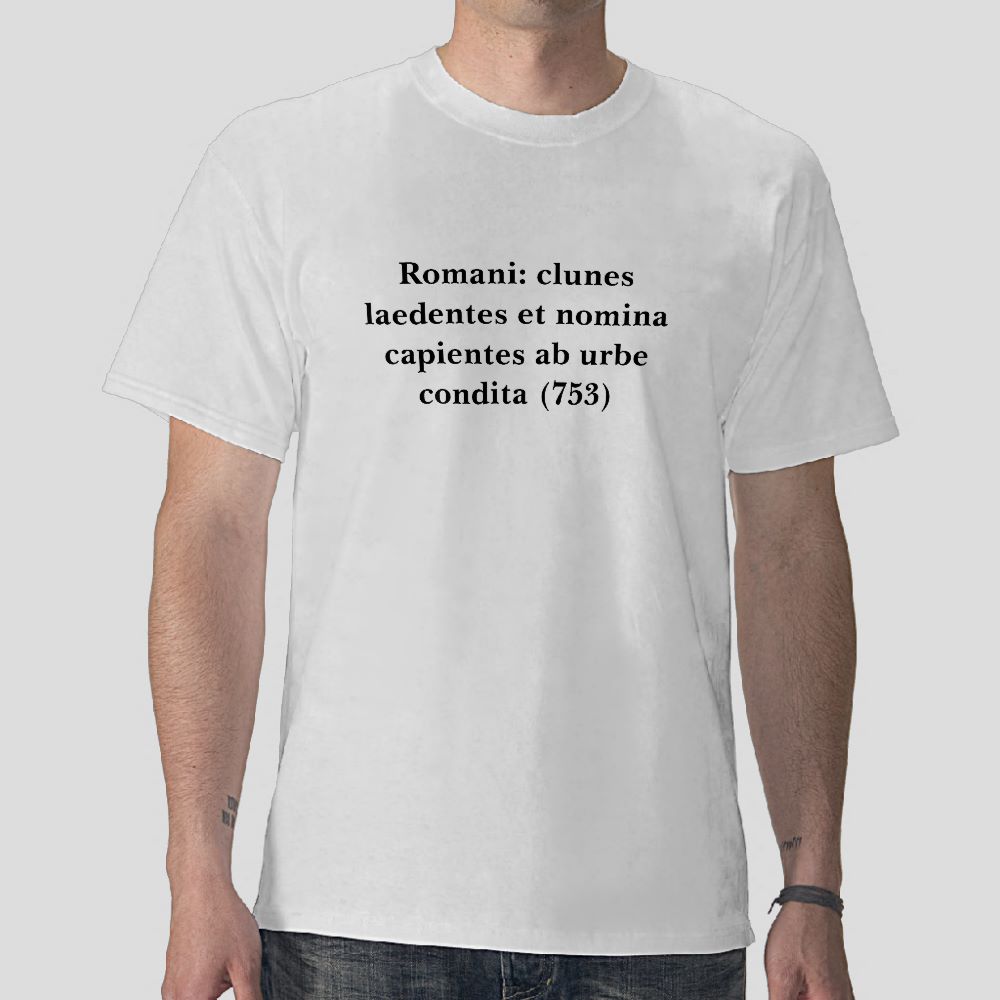
New t-shirt: "The Romans, kicking butt and taking names"
For the first time in a while, a new t-shirt in the Classics Daily shop: "Romani: clunes laedentes et nomina capientes ab urbe condita (753)" = "The Romans: kicking butt and taking names since the founding of the city (753)."
This design was inspired by a recent conversation with the spouse. We're eagerly awaiting season 2 of Game of Thrones (being poor folk who have to wait and watch it on DVD). I asked my husband what he thought our favorite character Tyrion Lannister might be up to, and he said, "oh, kicking a** and taking names."
Perhaps thinking of the many Roman emperors who overcame challenges in the service of butt-kicking (including the epileptic Julius Caesar), I thought the sentiment deserved a t-shirt.
UPDATED: now available as a mug. Pin It
Thursday, June 21, 2012
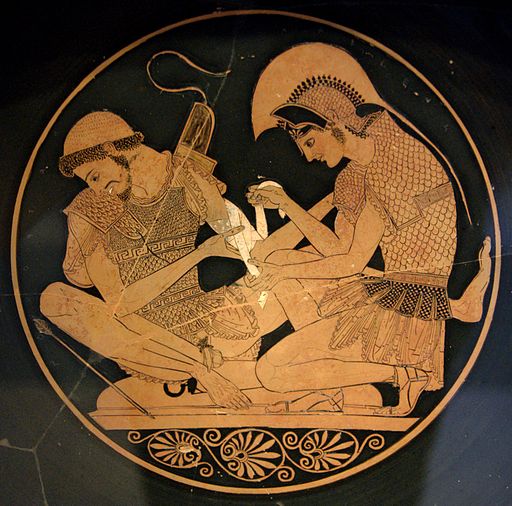
The Song of Achilles by Madeline Miller
Madeline Miller's novel is an engaging and quite moving version of the life of Achilles and Patroclus, whom she presents as lovers.
I understand how some Amazon reviews have a problem with the way battle scenes are presented. But this is not a book about the reality of war. That is made clear fairly early, when the young Achilles does not practice fighting in front of anyone else.
"My mother has forbidden it. Because of the prophecy.""What prophecy?" …."That I will be the best warrior of my generation."It sounded like something a young child would claim, in make-believe. But he said it as simply as if he was giving his name. (p. 38)
Later, Patroclus describes Achilles' fighting as something from which Achilles himself is quite detached ("'They could not get close enough to touch me,' he said. There was a sort of wondering triumph in his voice." [p. 222]). The Trojan war has such a heavy admixture of the supernatural that realistic battle scenes would be out of place.
The heart of Miller's story is the time the boys spend with Chiron on Mount Pelion. Going to Pelion is the first substantial risk Patroclus takes for Achilles' sake. His mother Thetis believes Patroclus is too lowborn and too ordinary to be her son's companion, and has expressly forbidden that he accompany Achilles. After a trial period Chiron allows him to stay anyway. Warfare is (perhaps surprisingly) not a focus of Chiron's teaching. Rather, the boys learn music, healing, survival skills and ethics. When the couple is at Troy and living under the shadow of Achilles' imminent death Patroclus frequently recalls conversations they had or skills they learned on Pelion.
Chiron had once said that nations were the most foolish of mortal inventions. "No man is worth more than another, wherever he is from."
"But what if he is your friend?" Achilles had asked him, feet kicked up on the wall of the rose-quartz cave. "Or your brother? Should you treat him the same as a stranger?" (p. 298)
In conclusion, Miller's Patroclus may well be more sensitive and articulate than were most Bronze Age Greek men, and the experience of average people in war is given rather short shrift. But her observant and emotionally astute hero gives us a marvelously detailed portrait of Homeric society, the imagined prehistory of Greece.
image credit
Pin It
image credit
Subscribe to:
Posts (Atom)