 |
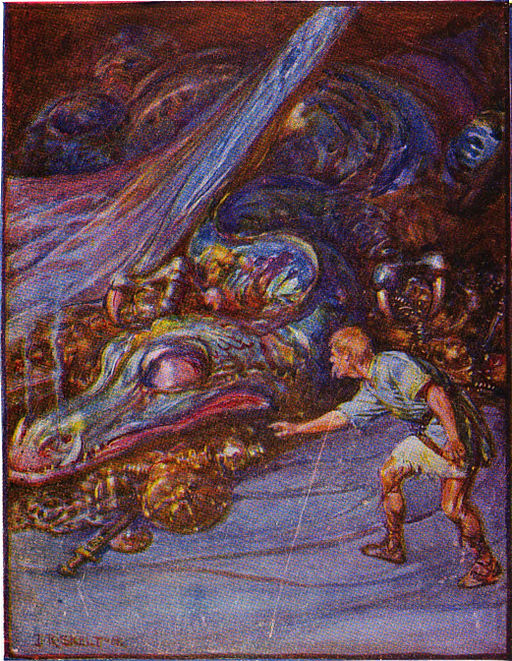
| The dragon's hoard from Beowulf |
I recently read From Villain to Hero: Odysseus in Ancient Thought, a book about Odysseus' role as a philosophical hero post-Homer. The philosophical schools that co-opted Odysseus as a spokesman, or at least an exemplar of their teaching, always had to deal with his love of stuff, his attachment to material gain. Plato, for example, shows Odysseus receiving a new life as a philosopher in the Myth of Er, in part so that he can circumvent the issue of the Homeric character's greed (49 and passim).
I thought this was rather unfair of the philosophers (she said anachronistically). I've always understood timē (pronounced teemai), the desire to get stuff as a sign of status, to be a widespread (and perfectly respectable) Homeric value. Epic heroes in other cultures do it too. Beowulf dies happy knowing that he's gained lots of gold for his people by slaying the dragon who was guarding it.
Margalit Finkelberg (Time and Arete in Homer, CQ 48:1 (1998) 14-28) is illuminating on this point. She argues that timē is an aristocratic value already outdated by the time our Iliad was composed. In speeches, the most flexible part of the poem, the egalitarian value of aretē is uppermost.
Poseidon's speech to the Greeks in Iliad 14 and the description of the Greek army at the beginning of Iliad 3 stress acting for the benefit of the community, the essence of aretē (27). Homeric performers in the eighth century and after praised aretē but preserved the role of timē because it was essential to the plot. After all, Achilles and Agamemnon didn't quarrel over who could benefit the community most.
As I read example after example of urban philosophers criticizing or ignoring Odysseus' love of profit, it occurred to me that city life doesn't exactly make poverty easier, but it makes the single-minded acquisition of wealth less necessary. Lots of smart and motivated people enjoy living in tiny apartments in New York who would need a lot more space and things to be happy where I live.


