Showing posts with label Odysseus. Show all posts

Wednesday, August 7, 2013

Metis


Metis is one of the most difficult to define Greek words. It's a person, the first wife of Zeus, who he ate -- naturally -- to keep her from bearing a son who would take over. If you're familiar with Detienne and Vernant's book on the subject, you might define it as "cunning intelligence," from the book's subtitle. 

Metis is morally ambiguous: praiseworthy when employed by Odysseus to entrap Trojan spies and strategize a way into Troy, but a negative quality by the time of Euripides' Iphigenia at Aulis. Odysseus' metis in Iphigenia is so negatively portrayed that it allows the poet to pin the responsibility for Iphigenia's death on him, rather than on her father, who is to kill her, or her uncle, who started the war that made it necessary.

What's got me thinking about metis is some things I've read lately about the economy and the responsibilities of the younger generation. I see a tendency to expect metis of everyone in this modern world, and it makes our world more fragmented and angry. The Greeks, who invented cleverness and deception in the West, never envisioned a world where everyone would need to second-guess their neighbors and their public institutions on a daily basis. Maybe we should remember that cunning functions best when it's used only when necessary.  

Pin It

Sunday, May 26, 2013

What were people like before personalities?


It might seem strange that I've just begun thinking about ancient concepts of personality, considering that I'm 50 pages into a novel narrated by a Mycenaean Greek. But it's true -- my protagonist has just set sail for Troy, and I find myself wondering what he would have thought about for those ten years, and what would have motivated him to commit war atrocities like flinging children off of towers. 

Historical fiction is based on the premise that you can 'know' people from the past -- understand their lives and motives well enough to want to read about them for pleasure. How strange were people from the past? How could they do some of the awful things they did, and still think of themselves as good? Did they care about thinking of themselves as good people? If not, how did they want to see themselves? When questions like this start coming think and fast, I know my fiction writing is going to be stalled for a bit.

Many years ago I remembered reading- or hearing about - somebody who argued that the archaic Greeks formed their self-concept based on what other people said about them, which is why Hector fights in order to avoid "feeling shame before the Trojans and the Trojan women with trailing garments." I think the idea originated with Bruno Snell, but I can't find the passage. His chapter "Homer's View of Man" seems to be building towards some such point through a discussion of how Homeric Greek sees spirit, mind and psyche as separate entities, self-contained like any other bodily organ. 

How do you write about someone like that? What do that person's thought processes look like? I had little trouble showing Odysseus at home in Ithaca and marrying him off. These are universal, uncontroversial experiences. But leading soldiers in the Trojan war is an experience utterly unique to that (mythical) place and time, and so the character's motives become harder to imagine. There's the added difficulty of dirus Ulixes, the scarily detached and cruel Odysseus of the Iliad who seems so at odds with the intellectually curious explorer and dedicated husband of the Odyssey. If his spirit, mind and psyche operate separately, that might make it easier for him to commit atrocities like the betrayal of Dolon or the killing of Astyanax. On the other hand, where is the 'real' person in all this, the individual with whom a modern reader can sympathize? A tentative answer in my next post.
Pin It

Thursday, August 30, 2012

Epic heroes and their stuff

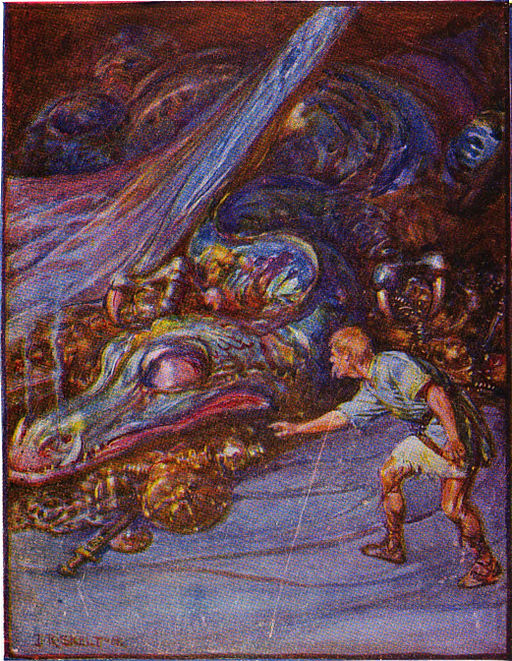
The dragon's hoard from Beowulf

I recently read From Villain to Hero: Odysseus in Ancient Thought, a book about Odysseus' role as a philosophical hero post-Homer. The philosophical schools that co-opted Odysseus as a spokesman, or at least an exemplar of their teaching, always had to deal with his love of stuff, his attachment to material gain. Plato, for example, shows Odysseus receiving a new life as a philosopher in the Myth of Er, in part so that he can circumvent the issue of the Homeric character's greed (49 and passim).

I thought this was rather unfair of the philosophers (she said anachronistically). I've always understood timē (pronounced teemai), the desire to get stuff as a sign of status, to be a widespread (and perfectly respectable) Homeric value. Epic heroes in other cultures do it too. Beowulf dies happy knowing that he's gained lots of gold for his people by slaying the dragon who was guarding it.

Margalit Finkelberg (Time and Arete in Homer, CQ 48:1 (1998) 14-28) is illuminating on this point. She argues that timē is an aristocratic value already outdated by the time our Iliad was composed. In speeches, the most flexible part of the poem, the egalitarian value of aretē is uppermost. 

Poseidon's speech to the Greeks in Iliad 14 and the description of the Greek army at the beginning of Iliad 3 stress acting for the benefit of the community, the essence of aretē (27).  Homeric performers in the eighth century and after praised aretē but preserved the role of timē because it was essential to the plot. After all, Achilles and Agamemnon didn't quarrel over who could benefit the community most.

As I read example after example of urban philosophers criticizing or ignoring Odysseus' love of profit, it occurred to me that city life doesn't exactly make poverty easier, but it makes the single-minded acquisition of wealth less necessary. Lots of smart and motivated people enjoy living in tiny apartments in New York who would need a lot more space and things to be happy where I live.

Pin It