Showing posts with label historical fiction. Show all posts

Tuesday, February 12, 2013

Review: Goddess of Yesterday


Goddess of Yesterday follows Anaxandra, daughter of a minor chieftain in Mycenaean Greece, sent as hostage to the king of Siphnos. When Siphnos is sacked she ends up in the care of Menelaus of Sparta, witnessing the theft of Helen and the start of the Trojan war.

Cooney's novel succeeds where other fiction about the Bronze Age (like the execrable Gates of Fire) fails, largely because of the naive narrator. A girl raised in isolation, Anaxandra has no pretensions to sophistication or anachronistic open-mindedness. Observing Helen of Troy and her family from a child's perspective, she feels the eerie attraction of the queen's beauty and the repulsiveness of her selfish heart, but does not try to rationalize away the contrast as an adult would. 

Anaxandra's youth also leads her to accept other Mycenaean customs such as the sacrifice of animals and humans in a natural manner. She imagines Agamemnon was shocked when the gods ordered him to "make his own daughter holy," but there is no pretense that he should have tried to second-guess fate. The romance between the heroine and the neutral king Evenus is innocent without being Victorian, and sparked by the 'new' custom of horseback riding.

Pin It

Sunday, November 11, 2012

The original 007


The opening of Skyfall this week connects to my love of historical novels via John Dee, an Elizabethan secret agent who signed his letters "007".

Dee was a mathematician and astrologer who taughts many of Elizabeth's advisers. The novel The Spymaster's Daughter emphasizes his interest in codes and his role in breaking the cipher used by Mary Queen of Scots.

The double 0 in Dee's signature stood for "your [Elizabeth's] eyes only" and 7 was chosen because of its cabalistic associations.

More historical novels involving Dee: Shadow of Night, The Queen's Fool

The John Dee Society is dedicated to publishing Dee's works and assembling a catalogue of his library, one of the largest in England before it was dispersed.

Pin It

Monday, January 23, 2012

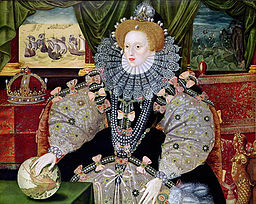
Elizabeth I by Margaret George


Since I found George's recent Helen of Troy slow, I thought I should report that her Elizabeth I is wonderful. The novel begins with the build-up to the first Armada and ends with Elizabeth's death. It is written in Elizabeth's own voice. I imagine it took courage to write in the first-person voice of one of the most inscrutable figures of early modern history.

I found the humility and weariness that shone through in Elizabeth's narration completely authentic and believable. It seems to me (the husband and I had a discussion of this after watching The Tudors), that Elizabeth's strength lay in her realistic assessment of her own power. In this she seems to have been the opposite of her megalomaniac father.

Which brings me to another thing I appreciated about this book -- that Elizabeth thought about her mother and father from time to time without making a huge deal out of it. At one point she thanks her mother for having the courage to seek a high-profile position in the world, and she often wishes she could discuss state affairs with her father. She doesn't agonize excessively over her parents' tortured history. That's believable to me. It's a remarkable story to us, but Elizabeth had lived with it all her life.

If you love historical fiction, give this book a shot. I got it as a Kindle ebook from my local library.

image credit Pin It

Tuesday, January 17, 2012

Uhtred of Bebbanburg returns!

I'm going to write (scholarly writing) for a couple of hours, and then reward myself with the new Uhtred of Bebbanburg novel, Death of Kings. The series (6 books so far) follows the adventures of a ninth-century Thor-worshipping Saxon warrior who loves to poke fun at the pieties and 'middle class values' of Anglo-Saxon life.

From The Burning Land (the previous book):

Next morning it was raining like the world was ending and so I waited until the wind and weather had done their worst. I roamed the monastery and eventually found myself in a dank corridor where three miserable-looking monks were copying manuscripts. An older monk, white-haired, sour-faced and resentful, supervised them. He wore a fur stole over his habit, and had a leather quirt with which he doubtless encouraged the industry of the three copyists. "They should not be disturbed, lord," he dared to chide me. He sat on a stool beside a brazier, the warmth of which did not reach the three scribblers. 
"The latrines haven't been licked clean," I told him, "and you look idle." 
So the older monk went quiet and I looked over the shoulders of the ink-stained copyists. One, a slack-faced youth with fat lips and a fatter goiter on his neck, was transcribing a life of Saint Ciaran, which told how a wolf, a badger, and a fox had helped build a church in Ireland, and if the young monk believed that nonsense then he was as big a fool as he looked. The second was doing something useful by copying a land grant, though in all probability it was a forgery. 

Pin It

Saturday, December 10, 2011

Animal Metamorphosis in Celtic and Classical Myth

via Wikimedia Commons
I just finished the delightful new novel The Scottish Prisoner, which makes extensive use of the Wild Hunt myth. The Wild Hunt is a widespread European myth (although, as Gabaldon points out in the author's note, not a native Celtic one.) It is a spectral group of hunters led by a mythological figure, frequently the Norse god Odin.

I vaguely recalled a story associated with the Wild Hunt about a girl having to pull her fiance out of the procession and hold him while the fairies transform him into a series of animals. I (again, vaguely) thought there might be interesting similarities between this story and the 'courtship' of Peleus and Thetis, in which he compels her to wed him by restraining her while she transforms. Actually reading up on these narratives made everything quite a bit more complicated.

The Wild Hunt story comes from a Scottish ballad called Tam Lin. Everything I told you above is true, except that the fiance is a) a fairy who b) assaults young women traveling through 'his' territory. Not to mention that c) his fiancee is pregnant and d) he's about to be given to the devil as the fairies' 'tithe to hell', a tax paid every seven years.*

His fiancee, Janet, wants to avoid having to marry an older knight she doesn't love just because she is pregnant. She has returned to Tam Lin's forest to obtain an herb that will cause her to miscarry. Tam Lin tells her how to turn him back into a mortal man, explaining that he believes he is about to be given to the devil by his fairy buddies. She does so and weathers the anger of the fairy queen to, presumably, live happily ever after.

Thetis is a minor goddess in the historical period in ancient Greece who may have been much more powerful in prehistoric times. Zeus would like to 'marry' (make baby gods) with her, but fears the prophecy that her son will be more powerful than his father. She is married off to the Greek hero Peleus to neutralize this threat. The sea god Proteus, an expert on metamorphosis, tells him how to overcome Thetis' transformative abilities. She agrees to marry him after he creeps up on her asleep and restrains her through a series of transformations into water, fire and serpents. Apart from his skill at goddess-abducting, Peleus is a rather unremarkable hero, a grandson of Zeus and a companion of Heracles, like most of the generation prior to the Trojan War.

The Peleus and Thetis myth is a distasteful story even by ancient standards. (Although the modern 'love match' was an alien concept, complaints about arranged marriages and the unequal treatment of goddesses are not unknown in Greek literature.) Surprisingly, I found that 'Tam Lin' was far less egalitarian than I remembered. Tam Lin commits serial assaults on woman and only agrees to marry Janet because it's better than an eternity spent in Hell. Janet is motivated less by love than a desire to avoid unwed motherhood or marriage to the "auld grey knight" who revealed her secret.

The differences between the stories come down to one thing: female agency. Neither myth reflects a romantic world, nor one particularly fair to women, but any ancient Greek would have been shocked at the notion of a woman lying in wait for a demigod lover and forcibly restraining him as a way of saving his life (so to speak). There are strong, forceful women (within limits) in Greek literature, but the total impossibility of a myth like Tam Lin reminds us not to look for Wonder Woman in the megaron.


*This is all based on the earliest version, Child 39 A.  The 'tithe to hell' plays an important role in Gabaldon's novel. Pin It

Tuesday, October 25, 2011

Does Amazon make books better or worse?

The NYT debated whether their burgeoning publishing arm hurts or helps publishers this morning. It might be simplistic, but I'm more interested in the above question than whether they are helping to drive a possibly-on-the-verge-of-irrelevant industry out of business.

I'm not sure, actually. As a confessed historical fiction addict, I've downloaded a handful of novels self-published on Kindle, and I haven't necessarily been wild about them. I'm more of a fan of established authors like Diana Gabaldon, Philippa Gregory and Elizabeth Chadwick.

But if I read a fabulous book, I certainly wouldn't care who had published it. As Michael Wolf writes:

Traditional publishers, unfortunately, don’t have a relationship with the reader -- or if they do, it’s extremely tenuous. Ask most consumers what publishers their favorite authors are aligned with, and 9 out of 10 couldn’t tell you. If you don’t have a relationship, you can be cut out, and this is what Amazon knows and what writers are learning.
Pin It

Thursday, September 15, 2011

What makes a good historical novel?

As a voracious reader of historical fiction, sometimes I wonder which is better: a novel about a famous person or a novel about a random person living in times of great upheaval? My favorite medieval fiction is split about evenly: Elizabeth Chadwick's and Philippa Gregory's novels usually revolve around a historically known main character, whereas the Outlander Novels and the works of Ellis Peters and Norah Lofts often don't.

If you are writing about a known person you are stuck with their often shockingly vivid flaws. Philippa Gregory has been criticized for the negative qualities she attributes to Anne Boleyn in The Other Boleyn Girl, although I believe her Anne is still sympathetic, and Mary is her real heroine anyway. But I have trouble wrapping my head around the idea of a "made-up person who encounters famous people/events" novel. It does involve working with the imagination on a different level, and sometimes you end up with a silly "Oh my goodness! I, a simple milkmaid, just happened to trip over George Washington!" type of thing. Pin It

Thursday, September 1, 2011

New read: Stealing Athena, by Karen Essex

While my Latin students were finishing their quiz this morning I downloaded a new historical novel, Stealing Athena. From the library's description of it I gathered that it's about Lady Elgin (as in Elgin marbles) and Aspasia, the mistress of Pericles. There's always initial skepticism when I come across a juxtaposing-time-periods kind of novel, but they are mostly very enjoyable in the end. A taste:

"I want you to behave meekly, and not at all like yourself,"Alkibiades said, dragging me by the arm at a pace faster than my tall platform shoes would allow me to walk. "If Perikles sees what you are truly like, he will promptly rescind any offer to help us." (48)
Pin It

Wednesday, May 25, 2011

Black Ships by Jo Graham

Black Ships is an historical novel based on the Trojan War, specifically on the events of Vergil's Aeneid. The narrator, Gull, is the offspring of a Trojan captive and Greek soldier. She becomes a priestess of the 'Lady of the Dead' (a pre-classical version of Persephone) after an accident leaves her unable to perform other work. When a war band led by Prince Aeneas arrives on a mission to rescue the captive Trojan women and children, Gull leaves with them and becomes their resident priestess.

Personally, I love historical fiction as a form of escapism, so the slightly slow-moving plot did not bother me. I'm all about enjoying the layers of detail and the recreation of a vanished world.  I enjoyed many elements of the storyline, such as Gull's romance with one of the Trojan captains and the time the group spends in Egypt. (Vergil's character Dido is transformed into an Egyptian princess called Bastaemon.) If you are intrigued by the ancient Greek and Near Eastern world and would like to learn more in an entertaining, engaging way, I would recommend Black Ships. Pin It