Showing posts with label Greek Mythology. Show all posts

Wednesday, March 13, 2013

I wish I could lecture like this: Zeus Grants Stupid Wishes


If you love myth, or just wish you could use more colorful language while teaching, check out Zeus Grants Stupid Wishes. A taste:

"… for a long, LONG time, the difference between a good story and a bad story was whether a bard could memorize it well enough to not get eviscerated by a mead hall full of drunken barbarians."

Discussing Cronus:

"So the moral of the story
is that if you are not ready to be a father
consider all of your options
before skipping directly to cannibalism."

I'm still reading it, so I'll no doubt have more quotes to share.

Pin It

Sunday, October 7, 2012

A Facade of Busyness


The Lonely American is a favorite nonfiction book of mine, in large part because it makes intelligent use of myth. Olds and Schwartz begin by deconstructing the myths surrounding independence and productivity in American culture, and return to that theme throughout the book.

"Productivity is a virtue in America. Busyness itself is a virtue in America. And because busyness is virtuous, it has "legs." When necessity recedes, the busyness does not stop. It continues not only because it is a habit but because it is a "good" habit. And since busyness is a public virtue, a boast as well as a complaint, since people want to be seen as virtuous even in those moments when their virtues are flagging, they sometimes present a facade of busyness to the world whether they are being productive or not." (14-15)

I"m always trying to get my myth students to look at the relevance of Greek myths in ancient life (however reluctant they sometimes are). So I'm wondering what myths had a consistently negative effect on life in the ancient world. I'm going to do a little reading in De Officiis and Works and Days, and post an update.

Pin It

Saturday, June 2, 2012

Mythology and Place


I have been thinking a lot lately about place: the significance of actual, physical locations. Ancient Greece and Rome are often described as essentially imaginary places. The ability to conduct a productive career in Classics with only occasional, brief visits to modern Greece and Rome supports that idea to a certain extent. 

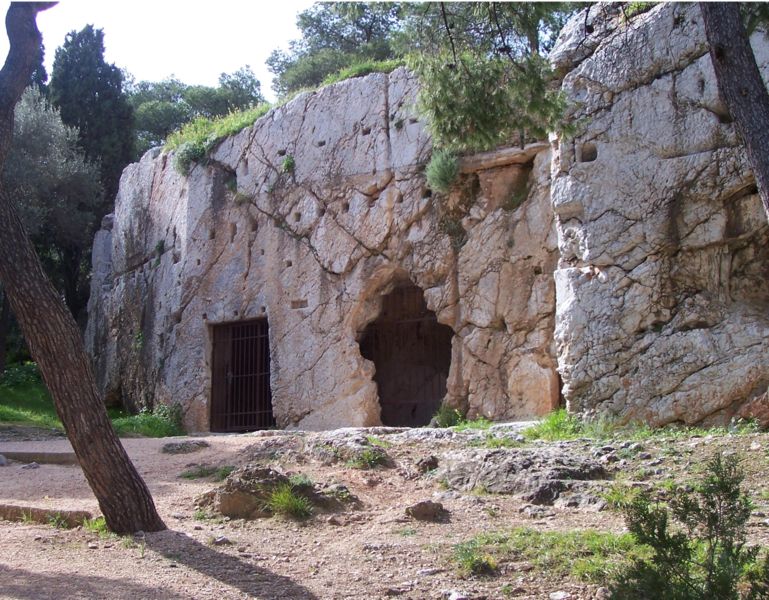
Yet the popular imagination inevitably connects the civilization and the place. Innumerable articles make cutesy references to Zeus or Socrates before getting down to a discussion of the current economic crisis. Visitors flock to an Athenian cave  because it's billed as 'Socrates' prison'.

Entirely fictional worlds can seem real too, with a wealth of invented detail often substituting for a basis in real-world history. There are no doubt many classicists who loathe the fiction of Tolkien and George R.R. Martin, but many more who find these fictive environments highly congenial, with their emphasis on myth and the moral imagination.

Ultimately we may love visiting the places where our favorite authors and historical figures lived for the same reason that we once loved tree houses and backyard forts.* They allow our imaginations, so often squelched in the pursuit of scholarly rigor, free rein.

*I'm thinking primarily of literary scholars rather than archeologists, although I'm sure they also experience an imaginative connection to their work.


Pin It

Tuesday, May 22, 2012

The meander isn't much of a symbol


I was thinking of doing a post on the meander's symbolism in ancient Greece, since the loathsome Golden Dawn has adopted it as an emblem, supposedly because of its Greekness and not because it looks like a Nazi symbol.

I discovered that for the ancient Greeks it symbolized ... not much. It's an archeological decoration named for a river with a bend in it, the Meander in Asia Minor. It may at times indicate the labyrinth of Greek mythology, in connection with the worship of the god Dionysus. But the subtlety of the labyrinth hardly seems relevant to a party whose platform is a straight rejection of all immigrants, even legal ones.

I thought "aha! the lack of meaningful symbolism indicates that they did choose it for its suggestions of Nazism."

Turns out this is a moot point, because they are being increasingly obvious about their fascist leanings. They just happen to like eagles, they just happen to adopt Nazi slogans.

Hopefully the Greeks' difficulties forming a government will save them from these wackos, and they will get a smaller proportion of the vote in the next election.

image credit Pin It

Thursday, April 19, 2012

Classical myth and the Hunger Games


I planned to base a mythology lesson on The Hunger Games, although ultimately it did not fit into the schedule. Although I enjoyed the book, and thought there were a lot of general parallels with the classical world, the movie really brought the classical parallels into focus for me.

1. Theseus and the Minotaur
This is the source mentioned on Suzanne Collins's Wikipedia page. I have to say, I mocked Athens quite a bit in class this semester (Hercules murdered his whole family! But then Theseus takes him to Athens where anything can be fixed!). So I have a hard time getting really into this as a source myth. I'm not saying that THG is not a worthy modern interpretation, just that the comparison doesn't fire my imagination.

2. Antigone
This is a parallel the movie brought into focus quite beautifully for me. Covering Rue with flowers and gesturing accomplished in a couple of minutes much of what it took Sophocles hundreds of lines (and one really annoying heroine) to do.

3. The Iliad
Something about the luminous lighting in President Snow's garden (and his revolting detachment from the Games) really suggested the Greek gods to me. Maybe this is the approach the next movie about Greece should take -- skip the togas and just get a really scary white-haired man in a rose garden to play Zeus. Pin It

Tuesday, April 17, 2012

Achilles the vampire?


Last week's myth class perked up briefly when, in a sudden fit of inspiration (desperation?), I compared Achilles to a vampire. Prior to the poems' conclusion, he stops needing to eat and reaches almost demonic heights of rage, so I said that he was "almost an undead figure." The students seemed quite taken with this idea.

No doubt if I rewrote the poem to include some zombies and vampires (a la Jane Austen), some of them would actually read it.* Never mind that the work's humanity is supposed to be the point ...

*Emboldened by the fact that I'd already given the evals, I asked recently if anyone had actually done the reading. (This was after asking several factual questions about the text that no one would answer.) The response was, shall we say, less than heartening.

photo credit Pin It

Tuesday, March 27, 2012

Greek myth and the Hunger Games?


I want to/ consider it strategic to do some 'modern myth' before the semester ends in my Greek Myth class. I'd really like to break away from the old "Star Wars! Look, Luke is on a Hero's Journey!" type of thing.

And so, a question for my readers: have you tried to incorporate recent fantasy works or adaptations of Greek myth into your classes? E.g. Harry Potter, the Hunger Games series? How did it go? Pin It

Tuesday, January 10, 2012

Is Mythology a made-up subject?

via Wikimedia Commons
So, another semester of Mythology. It's an important class for my department, a great way to get students interested in the ancient world, etc. But ... what is it supposed to be about?

I just wonder every time I teach it, what is it other than a low-level survey of ancient literature? I throw in some mythological theory just to try to be somewhat true to the subject matter. But I feel like that's more relevant to the later works that use Greek mythology than it is to the original works themselves. Especially if that's all you're going to read.

Take Oedipus Rex, for example (Please :)). It's clearly compelling to interpret it from a psychological standpoint. So we read it and talk about the characters' psychology. I feel like I should then go and try to interpret it using one of the other theories of myth we've studied. The ideological approach, perhaps.

But most undergrads (especially those with a very firm idea of what a lower-level class should be like) won't go there with you, frankly. The idea that you explain a work one way and then turn around and explain it the other way is something they're not willing to entertain.

So you end up reading OR and then talking about psychology. Exactly like you would do in a lit. survey course.

Myth might be a more meaningful course if you could span time periods a bit more. Read Greek tragedy and then some of the neoclassical works by Racine, the Odyssey and then a bit of Joyce, maybe. But again, students are overwhelmingly likely (in my opinion) to see that as exceeding one's brief. And maybe they're right. Pin It

Monday, December 19, 2011

Those darn Furies, always so vengeful

I'm on a (very long) waiting list for Fury at the public library. Today I thought I'd drop by Amazon and check out the reviews. I was quite amused.

Fury is a tale of high school students punished for juvenile misdeeds by the ancient Greek goddesses of vengeance. Some of the reviews complained of uneven pacing and wooden dialogue. Okay, fine. As a longtime fan of Simon Pulse for escapist reading (I devoured Samurai Girl and The Nine Lives of Chloe King) I'm not expecting The Brothers Karamazov.

But there are also repeated complaints that the Furies are too harsh (potentially punishing every transgression with death), illogical and 'favor revenge.' Is this pressure on YA fiction for warm-fuzzy morals a new thing?

I fear that this reflects what my students, just out of high school themselves, expect of mythology. Thus, instead of examining how Greek literature illuminates the human condition in all its breathtaking ugliness and glory, I'm going to have to spend the next semester talking about why the gods are immature. (Akin to talking about why Greek heroes love to fight. They just do. It's what they did.)

May the Fates send me a more imaginative group than that. (Not that I expect them to be 'fair' or anything...)

Pin It

Saturday, December 17, 2011

Why the Romans Celebrated a Child-Killing Patricide

Io, Saturnalia! shirt
Io, Saturnalia! Tee
Today is the first day of Saturnalia, the great winter festival of the ancient Roman calendar. On the face of it, it doesn't speak well for the Romans that one of their major holidays celebrated Saturn, a god perhaps best known for eating his own children.

But as with most Greek mythology, it is best to look beyond the borderline-nonsensical surface story to the larger cultural significance. And Saturn, of course, ruled over a golden age that only a dramatically transgressive act (like devouring your own offspring) could bring to an end.

As I look ahead to teaching mythology next year, and as I indulge my various modern-day guilty pleasures (like the BBC's Robin Hood series), I ponder the ridiculousness of many ancient and modern myths. I hope to show my students that they should then ask "Why is this myth ridiculous in this particular way? What does it tell us about the people who created it, believed in it and derived great satisfaction from the different versions of it?"
Io, Saturnalia! Mug mug
Io, Saturnalia! Mug 

Previous offerings in the Classics Daily shop:
Pin It

Saturday, December 10, 2011

Animal Metamorphosis in Celtic and Classical Myth

via Wikimedia Commons
I just finished the delightful new novel The Scottish Prisoner, which makes extensive use of the Wild Hunt myth. The Wild Hunt is a widespread European myth (although, as Gabaldon points out in the author's note, not a native Celtic one.) It is a spectral group of hunters led by a mythological figure, frequently the Norse god Odin.

I vaguely recalled a story associated with the Wild Hunt about a girl having to pull her fiance out of the procession and hold him while the fairies transform him into a series of animals. I (again, vaguely) thought there might be interesting similarities between this story and the 'courtship' of Peleus and Thetis, in which he compels her to wed him by restraining her while she transforms. Actually reading up on these narratives made everything quite a bit more complicated.

The Wild Hunt story comes from a Scottish ballad called Tam Lin. Everything I told you above is true, except that the fiance is a) a fairy who b) assaults young women traveling through 'his' territory. Not to mention that c) his fiancee is pregnant and d) he's about to be given to the devil as the fairies' 'tithe to hell', a tax paid every seven years.*

His fiancee, Janet, wants to avoid having to marry an older knight she doesn't love just because she is pregnant. She has returned to Tam Lin's forest to obtain an herb that will cause her to miscarry. Tam Lin tells her how to turn him back into a mortal man, explaining that he believes he is about to be given to the devil by his fairy buddies. She does so and weathers the anger of the fairy queen to, presumably, live happily ever after.

Thetis is a minor goddess in the historical period in ancient Greece who may have been much more powerful in prehistoric times. Zeus would like to 'marry' (make baby gods) with her, but fears the prophecy that her son will be more powerful than his father. She is married off to the Greek hero Peleus to neutralize this threat. The sea god Proteus, an expert on metamorphosis, tells him how to overcome Thetis' transformative abilities. She agrees to marry him after he creeps up on her asleep and restrains her through a series of transformations into water, fire and serpents. Apart from his skill at goddess-abducting, Peleus is a rather unremarkable hero, a grandson of Zeus and a companion of Heracles, like most of the generation prior to the Trojan War.

The Peleus and Thetis myth is a distasteful story even by ancient standards. (Although the modern 'love match' was an alien concept, complaints about arranged marriages and the unequal treatment of goddesses are not unknown in Greek literature.) Surprisingly, I found that 'Tam Lin' was far less egalitarian than I remembered. Tam Lin commits serial assaults on woman and only agrees to marry Janet because it's better than an eternity spent in Hell. Janet is motivated less by love than a desire to avoid unwed motherhood or marriage to the "auld grey knight" who revealed her secret.

The differences between the stories come down to one thing: female agency. Neither myth reflects a romantic world, nor one particularly fair to women, but any ancient Greek would have been shocked at the notion of a woman lying in wait for a demigod lover and forcibly restraining him as a way of saving his life (so to speak). There are strong, forceful women (within limits) in Greek literature, but the total impossibility of a myth like Tam Lin reminds us not to look for Wonder Woman in the megaron.


*This is all based on the earliest version, Child 39 A.  The 'tithe to hell' plays an important role in Gabaldon's novel. Pin It

Monday, December 5, 2011

'Though I loved you well, I wooed you not': Troilus and Cressida's mythological roots

I posted recently about the Recuyell of the Historyes of Troy, the dominant version of the Trojan war myth before the western world rediscovered ancient Greek. An anecdote from the Recuyell inspired Shakespeare's Troilus and Cressida. 

via Wikimedia Commons
Cressida is someone I've thought about from time to time since that post. She does not appear in the ancient version of the Troy myth; her name is a corrupted version of Chryseis and in some medieval works she is called Briseida (which of course is a corrupted version of Briseis). 

Anyway, medieval audiences could not get enough of her and the love triangle between her, Troilus (a Trojan) and the Greek warrior, Diomedes. She betrays Troilus by starting an affair with Diomedes after being captured by the Greeks. Okay... I'm obviously intrigued by a worldview where a captured woman carries on optional 'affairs' with her captors. (She is, admittedly, a hostage rather than a woman captured in a city-sacking.)

And most of all, what about Helen? Why invent this character when you seemingly have a perfectly good unchaste women available? I'm wondering if it has to do with the medieval notion of the divine right of kings: Helen couldn't play the role of the corrupt woman because, as a queen, she was purer than the rest of the human race. I would love to read about this more (and hopefully I'll remember to do so in about 6 years when I have time ...)

Pin It

Monday, November 7, 2011

'The World of Odysseus'

via Wikimedia Commons
Published in 1965 (rev. ed.), before the footnote revolution, The World of Odysseus is wonderfully clear and straightforward. Of course, some of what it says is (according to modern scholarship) exaggerated or irrelevant. For example, Finley is at pains to argue that the Greeks were not "primitive," and the scholar in me wants to know 1) what does he mean by primitive and 2) what does it matter?

Denial that the Greeks were 'primitive' is often an attempt to place Homeric epic apart and above the then-emergent field of comparative oral traditions. (Basically, the idea that you can learn about archaic Greek epic -- or any traditional epic -- by comparing it with epic traditions from other cultures.) Finley is fair-minded about this, according to his lights. In his appendix "The World of Odysseus Revisited," he argues that the Homeric-length poem recorded by the Slavic bard Avdo Medjedovic is inferior in quality to the Odyssey but that the methodology of oral tradition is still valid (143).

It is a great pleasure to read a book about the Odyssey and about those whose experiences shaped it (rather than a book about the other books about the Odyssey, which is how I would describe many more recent works in this field). The chapters on "Wealth and Labour," and "Household, Kin and Community" deal in a measured way with topics that are frequently underrepresented in classical scholarship. More recent works that covers these topics are often hijacked by trendy subfields, but Finley manages to cover them thoroughly and unemotionally, as far as I can tell. In "Wealth and Labor," his argument that the worst-off person was not a slave but a thes, an unattached person, was particularly cogent and striking (57ff). In "Household, Kin and Community" he vividly describes a world where almost none of a household's business had public relevance unless the head of household chose to make it so. His point is well taken since, with Homer as the foundation of Greek literature, classicists are sometimes tempted to fit 'the world of Odysseus' into the mold of a classical polis.

The World of Odysseus would be an excellent introduction to the background of the Iliad and Odyssey. It is also (as is pretty well apparent in my review) a great refresher for anyone already acquainted with the poems who is worn out by the tendentiousness of much current scholarship.

Pin It

Tuesday, September 27, 2011

Let's hear it for Tyche

via Wikimedia Commons
Tyche, a goddess whose name can mean "happenstance" or "chance," ruled over the destinies of Greek cities. (Her Roman name is Fortuna, but it sounds so much better, because it is less familiar, in Greek.) Her crown, the one worn by the statue at right, represents a city's walls. The Greeks attributed to her all events in a city's history that had no rational explanation: floods, fires and, one hopes, some positive occurrences as well.

Something I find most instructive about the ancient world is how much harsher it was than our own. How much more random, even how much more boring. In the face of terrible disasters with no safety net, the Greeks were comforted by worshipping at the altar of randomness personified.

Reading some of the posts about the academic job market over at College Misery (oh, the memories!) started me thinking about Tyche vs. our straightjacketing sense of personal responsibility. As young academics, we are told that we are natural scholars and will be wonderful teachers. Then we encounter the job market, in which the odds are overwhelmingly against finding a good job. Rather than admitting this, our advisers and many advice books imply that changing some small detail about our applications or publications will of course change our luck. And what's more, we should have thought of this before and basically have no one but ourselves to blame that we have to spend another year on the market.

This is insane. We need to get with the idea that there are things outside our power. Including some of the more random comments on student evaluations. Including whether the topic of a junior scholar's handful of publications fits the handful of tenure track jobs available in his or her field. The Greeks knew it wasn't all up to them.

Let's hear it for Tyche, a divinity whose time has come. Pin It

Thursday, May 19, 2011

Thor and Greek Mythology


Although the movie Thor is ultimately based on Norse mythology, the beliefs of pre-Christian peoples living in northern Europe, you may feel that there is a certain amount of resemblance between the Asgardians and the gods of Greek mythology. And you would be right. The ancient Greeks and the pagan Norse shared a common cultural heritage.

Both Ancient Greek and the Norse languages are based on Indo-European, the tongue of a people who invaded/migrated across Europe, India and parts of Asia about 6,000 years ago. This linguistic inheritance was accompanied by a cultural interitance, including a polytheistic religion overseen by a sky god (Zeus/Odin). Both religious systems include trickster figures (Hermes/Loki) and warrior deities (Thor/Athena/Ares).

Pin It