Showing posts with label medieval. Show all posts

Friday, March 15, 2013

Medieval People Doing Things


Elizabeth Chadwick, one of my favorite medieval fiction writers, blogged this video as one of her 'Friday Favorites' last week:


This is the kind of thing that is going to be roundly mocked by those without a soft spot for the middle ages. I might have liked a few more examples of illuminations from the manuscript, but there's still much to enjoy. I love the low-key, intensely practical daily activities and the 'clutter with a purpose' in the inside rooms: i.e., I have all this crap on a shelf because I'm making all my family's clothes or creating a beautiful book, not because I'm a hoarder.

Plus, toddlers love it. Lots of animals.


Pin It

Sunday, July 29, 2012

"a history book that ... prioritised the reader's interests"


I discovered the wonderful Ian Mortimer recently through an interview with Medievalists.net. Mortimer writes popular history in non-traditional formats (such as a daybook and traveller's guide):
"There are, of course, those who argue ... that we cannot presume that people in the past were anything like us. But such a line of argument is both self-defeating and false. It is false because, if we deny the humanity of the past, then we cease to study history, for history is specifically the history of our species – the past of uninhabited islands and other species belongs to other areas of enquiry."
"A succinct way of illustrating the difference is to say that I am studying humanity over time (then and now) whereas traditional academics study evidence from the past."  
Pin It

Sunday, April 1, 2012

It worked for Heath Ledger and Queen

Filmmaker to bring the Middle Ages and Rap together in ‘The Quickener’

Pin It

Tuesday, January 17, 2012

Uhtred of Bebbanburg returns!

I'm going to write (scholarly writing) for a couple of hours, and then reward myself with the new Uhtred of Bebbanburg novel, Death of Kings. The series (6 books so far) follows the adventures of a ninth-century Thor-worshipping Saxon warrior who loves to poke fun at the pieties and 'middle class values' of Anglo-Saxon life.

From The Burning Land (the previous book):

Next morning it was raining like the world was ending and so I waited until the wind and weather had done their worst. I roamed the monastery and eventually found myself in a dank corridor where three miserable-looking monks were copying manuscripts. An older monk, white-haired, sour-faced and resentful, supervised them. He wore a fur stole over his habit, and had a leather quirt with which he doubtless encouraged the industry of the three copyists. "They should not be disturbed, lord," he dared to chide me. He sat on a stool beside a brazier, the warmth of which did not reach the three scribblers. 
"The latrines haven't been licked clean," I told him, "and you look idle." 
So the older monk went quiet and I looked over the shoulders of the ink-stained copyists. One, a slack-faced youth with fat lips and a fatter goiter on his neck, was transcribing a life of Saint Ciaran, which told how a wolf, a badger, and a fox had helped build a church in Ireland, and if the young monk believed that nonsense then he was as big a fool as he looked. The second was doing something useful by copying a land grant, though in all probability it was a forgery. 

Pin It

Saturday, December 31, 2011

Procrastination in the desert

via Wikimedia Commons
If you sometimes want to roll your eyes at yet another story on computer use as a threat to productivity, check out this piece on early medieval acedia. I'm pretty sure the desert fathers weren't on Facebook... Pin It

Thursday, December 15, 2011

Medieval art and red-and-green symbolism

via Wikimedia Commons
This BBC video on the origins of the Christmas color scheme is delightful. Stick with it past the mildly tedious bit about Coca-Cola imposing its own colors on Santa Clauss. It's worth it.

I love that the ultimate explanation has to do with the survival of medieval churches. I love pre-Renaissance churches (and Greek and Roman temples, for that matter.) These early churches have a naive and additive quality to their artwork that I find charming. Rather than presenting one designer's vision as many post-medieval churches do, these early churches are presenting a community's vision. Pin It

Monday, December 5, 2011

'Though I loved you well, I wooed you not': Troilus and Cressida's mythological roots

I posted recently about the Recuyell of the Historyes of Troy, the dominant version of the Trojan war myth before the western world rediscovered ancient Greek. An anecdote from the Recuyell inspired Shakespeare's Troilus and Cressida. 

via Wikimedia Commons
Cressida is someone I've thought about from time to time since that post. She does not appear in the ancient version of the Troy myth; her name is a corrupted version of Chryseis and in some medieval works she is called Briseida (which of course is a corrupted version of Briseis). 

Anyway, medieval audiences could not get enough of her and the love triangle between her, Troilus (a Trojan) and the Greek warrior, Diomedes. She betrays Troilus by starting an affair with Diomedes after being captured by the Greeks. Okay... I'm obviously intrigued by a worldview where a captured woman carries on optional 'affairs' with her captors. (She is, admittedly, a hostage rather than a woman captured in a city-sacking.)

And most of all, what about Helen? Why invent this character when you seemingly have a perfectly good unchaste women available? I'm wondering if it has to do with the medieval notion of the divine right of kings: Helen couldn't play the role of the corrupt woman because, as a queen, she was purer than the rest of the human race. I would love to read about this more (and hopefully I'll remember to do so in about 6 years when I have time ...)

Pin It

Thursday, November 17, 2011

'Recuyell of the Historyes of Troy'

via Wikimedia Commons
I've been reading In Search of the Trojan War by Michael Wood (full review coming soon). Wood has a detailed discussion of the the Troy myth's on medieval literature, noting that most medieval works about are based on something called The Recuyell of the Historyes of Troy. The Iliad and Odyssey were virtually unknown; The Recuyell was the 'Homer' of this period. (It was also the first book printed in English, in 1475.)


I liked the sound of this work; as a dead languages nerd I was especially pleased that its very archaic English has not been updated. I did a little digging on it today (in between trying to get undergraduates interested in Latin personal pronouns -- ugh!). Here is a sample, from the reign of Saturn:
By the moyen of these thynges the renomee of kyng Saturn grewe. And the worlde was that tyme of gold, that is for to saye hyt was moche better and more haboundant in the dayes of mannes lyf and in plente of frutes of the erthe than in ony other tyme after. (Recuyell pp. 16-17)

How sweet would it be to offer an English class on the postclassical reception of the Trojan war? A girl can dream...

Pin It

Friday, September 23, 2011

Christine de Pizan

In high school I was both unpopular and an underachieving student (my parents were thrilled :)) I would ride my bike around daydreaming, and once I passed a tiny, scholarly-looking bookstore about 4 miles from my house. I walked in and bought Christine de Pizan's The Book of the City of Ladies.

Yesterday I pulled it off the shelf and was fascinated anew by its blend of scholarship and surprisingly assertive proto-feminism. de Pizan, daughter of a Venetian court astronomer, married at 15 and was widowed (with three children!) at 25. She turned to writing to support herself, her children, a niece and her aged mother.

The Book of the City of Ladies describes her plain astonishment at the poor opinion of women put forth by intellectuals in her day. She strongly feels this is contradicted by common sense, if nothing else (I am at Starbuck so I can't provide the direct quote). Much of the rest of the book is taken up with examples of virtuous women from classical antiquity and the Bible. I certainly envy her the cheerful confidence with which she discusses her examples. (I suppose in the 14th century it was a lot easier to be sure you had consulted all available sources! Those were the days ...)

Another thing I enjoy about her book is the anecdote at the beginning, which is strikingly reminiscent of a modern personal essay. I can quote that bit from the text sample at Amazon: "One day I was sitting in my study surrounded by books of different kinds, for it has long been my habit to engage in the pursuit of knowledge. My mind had grown weary as I had spent the day struggling with the weighty tomes of various authors whom I had been studying for some time."* I assume most of my readers know what that's like.

* tr. Rosalind Brown-Grant Pin It

Thursday, September 15, 2011

What makes a good historical novel?

As a voracious reader of historical fiction, sometimes I wonder which is better: a novel about a famous person or a novel about a random person living in times of great upheaval? My favorite medieval fiction is split about evenly: Elizabeth Chadwick's and Philippa Gregory's novels usually revolve around a historically known main character, whereas the Outlander Novels and the works of Ellis Peters and Norah Lofts often don't.

If you are writing about a known person you are stuck with their often shockingly vivid flaws. Philippa Gregory has been criticized for the negative qualities she attributes to Anne Boleyn in The Other Boleyn Girl, although I believe her Anne is still sympathetic, and Mary is her real heroine anyway. But I have trouble wrapping my head around the idea of a "made-up person who encounters famous people/events" novel. It does involve working with the imagination on a different level, and sometimes you end up with a silly "Oh my goodness! I, a simple milkmaid, just happened to trip over George Washington!" type of thing. Pin It

Tuesday, September 13, 2011

Wonders of the medieval world

Check out Salon.com's slideshow, with commentary, of beautiful and significant things that started in the middle ages: elaborate geometric wall art, universities, illuminated manuscripts, advances in engineering, and more. Pin It

Tuesday, September 6, 2011

"The spirit was approached through a multitude of sensory beauties"

The title to this post comes from the Guardian's slide show of the Treasures of Heaven exhibit now at the British Museum. Personally, I find the idea of saints' relics a little bit uncomfortable, especially in its more 'complete' forms (as with the bodies of saints displayed I have seen openly displayed in Italian and Greek churches). But it is true that these medieval works of gold, ivory and alabaster make you feel better just looking at them. They are so natural in their materials, and yet so permanent in their preservation of the artist's vision.

Medieval vividness and attention to detail is also on display at the Getty Museum's Medieval Gospels exhibit. I especially enjoyed the action figure-ish illustration of St. John (at the top of the page when you follow the link).
Pin It

Monday, August 29, 2011

The Middle Ages at Classics Daily

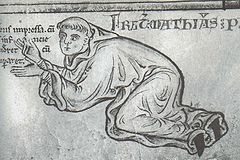
Matthew Paris' self-portrait
The classics news has been dull lately, so I've decided to start keeping up with the middle ages. Anyway, I like the middle ages, as my fondness for Elizabeth Chadwick will attest.

So, in medieval news this evening ...

A collection of medieval manuscripts is on view at the British Library. I love the detail and richness of medieval art (The fact that it is combined with a total inability to do realistic portraiture only makes it more charming):
 a 13th century map by Matthew Paris, one of the foremost English historians of the Middle Ages, plots the pilgrimage route from London through France and Italy to Jerusalem, finishing with a map of the Holy Land featuring crusaders' castles, churches, and even a camel. 
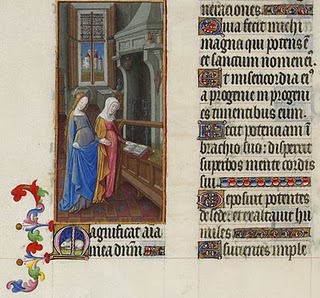
I have to share another favorite medieval painting of the Visitation, where Mary looks like she is pooching out her stomach to look extra pregnant (but I'm sure it's really because of the exaggerated symbolism of medieval art, etc.):

Pin It