Showing posts with label research and scholarship. Show all posts

Tuesday, May 22, 2012

The pressure on humanities faculty

I have a cousin who wants to become a professor in the humanities. My SO and I are horrified. We're not too miserable now, but we went through some really awful years and landed good jobs through sheer luck. We also fully expect the job market to be worse by the time cousin graduates.

My family is insistent that we not breathe a word of this. We're to be nothing but either neutral or supportive. I've gone so far as to recommend the Academic Job Search Handbook, but that's all. I've listened politely to a lot of talk from my aunt about how this career will 'fulfill' him.

A post on College Misery today reminded me why I want so urgently to warn my cousin. It's from someone who landed a tenure track job against all odds only to find out it's almost impossible to get tenure. 3/4 teaching load and 10-12 articles are required.
My biggest regret is not my “career failure” (I’ll be fine, in the end). Rather, it’s the fact that the state of higher education at this point in time leads to a glut of job seekers who should feel “lucky” to land a crappy job in a toxic department where they work under unreasonable conditions…as long as there’s dental! There’s something wrong with this system. 
SO and I are lucky enough to be at a school with very reasonable research requirements. Still, as an academic I've often found myself in situations similar to this one (an accomplishment turned nightmare because of crazy expectations). Is this the way things are going? Pin It

Tuesday, May 8, 2012

'Invisible classics daily: Narratives of Multimodal Composition'


Trying to get in a scholarly frame of mind to write my APA abstract. I'm looking at:

BMCR recent reviews

Abstracts from last year

I'm also having a laugh with the conference paper title generator mentioned recently on ProfHacker (see the title of this post).

If you're working on an APA abstract (or other conference paper) tonight, best of luck! May we all come up with ideas that are exciting, yet seem capable of being explained in 15 minutes ;)

image credit Pin It

Friday, February 24, 2012

Books about scholarly writing


Wow, I wish that were a more fun-sounding title. For many of us, research is a large part of what draws us into the profession. Then (for many of us, not all of course) we head out into the world with a less-than-clear idea of how to write a publishable article.


It's not that our ideas aren't good. It's just that, you know, it needs to sound right. There need to be scholarly footnotes. Lots of scholarly footnotes. And (in my experience) it needs to be an idea that meets a certain standard of proof, rather than the sort of fun notions we play around with in seminars or in conversations with friends.


As a big fan of the Academic Job Search Handbook, I am on a hunt for the ideal book on scholarly writing. Some candidates:


Writing Your Journal Article in 12 Weeks
I got this from interlibrary loan in a previous job. I gleaned some helpful things from it, but it's of limited usefulness unless you're in a position to follow their schedule (take an unrevised paper or dissertation chapter and revise it in 12 weeks).


Professors as Writers: a Self-Help Guide to Productive Writing
The only real thing I have against this book is that it sounds like something that would be handed out at new faculty orientation. The first review makes it sound ideal, though: "all of us academics would like to think that someday a muse will descend upon us and infuse us with the capability to write the great work in our field without self-doubt, procrastination, etc. Boice shows empirical evidence that demonstrates these hopes are in vain (which is no big surprise to anyone), but even better, he provides the solution: writing is like physical exercise--the more you do it, the easier and more pleasant it becomes--if you write a little bit every day, even if you think it's pointless, at the end of a six month period, you will have 150 pages of writing to edit." Actually, I'm quite tempted to order it after reading that.


How to Write a Lot: A Guide to Productive Academic Writing
This book came up quite a bit in reviews of other works about writing. From the comments, it seems more on the motivational than specific side. It appears to be especially effective at arguing procrastinators out of their rationalizations. (We've all -- or almost all -- been there). If you're starting from scratch in terms of writing regularly, this book may be for you.


If there are other books that have inspired you as an academic writer, please do share them in the comments.


image credit Pin It

Tuesday, February 14, 2012

Ancient Greece and Us

Michael Scott ("The Question of Life in the Ancient World") touches on some of the same themes as Mary Beard's "Do the Classics Have a Future?". A taste:
[M]ost newspaper articles either start or round up their coverage of the modern situation with some expression of nostalgic comparison to the glory days of ancient Greece. But to what exactly are we referring? Just what was life like in ancient Greece?
It's peripheral to his overall point, but I love that he's noticed this tendency of articles on the economic crisis to make token references to ancient Greek. It's particularly irritating to someone like me who relies on Google Alerts for blogging material and has limited interest (and expertise) in modern economics.

I came to grad school really excited about the 'relevance' of classics to the modern world, something that now makes me wince a little bit. Undergraduate programs often flog the relevance idea, understandably, as a way of attracting and keeping students. And of course I deeply believe that the study of antiquity is relevant to modern life. But there's discontinuity as well as continuity, which is why every single article about the economic crisis doesn't need to quote Solon, or refer to Athens as the birthplace of democracy.

Like Beard, Scott discusses the ongoing construction of 'the ancient world' in our minds:
In part because so little was known about the realities of ancient Greece in the 15th-17th centuries, the articulation of ancient Greece as an ideal rested upon modern re-imaginings of the pictures conjured up by ancient literature, populated with increasing numbers of pieces of ancient ‘art’ and architecture as they came to light, which were then ‘fitted in’ to that model. 
I spoke to an English class last month that was studying the Iliad, and I could tell it blew their minds a little bit to learn that until relatively recently, the Mycenaean world was regarded as quasi-fictional. Fascinating stuff.

H/T rogueclassicism Pin It

Friday, February 10, 2012

The 99% (of untranscribed papyri from Oxyrhynchus)

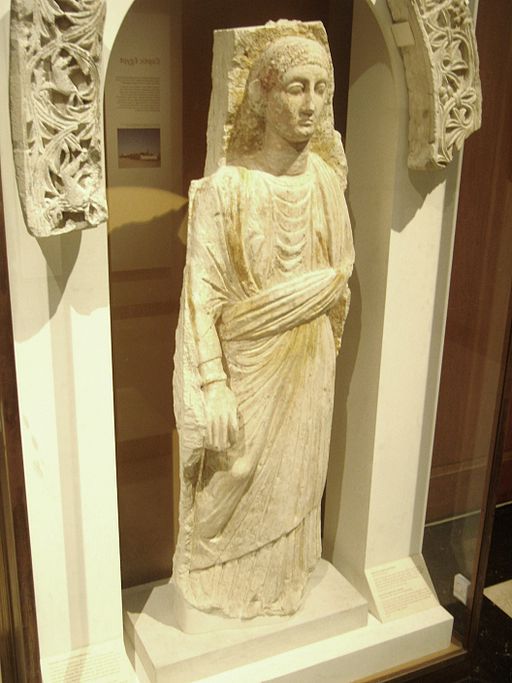
Funerary art from Oxyrhynchus
I've blogged about the Ancient Lives project before. If I had a lot more free time, it would be fun to go there and help decipher papyri. The site gives you a fragment of papyri and a Greek keyboard (there's a note saying "images must not be offloaded", or I would show you). Anyone at all can go to the site and try to match handwritten letters with keyboard letters. You don't even have to know Greek.

The University of Minnesota is working on an algorithm which, if I understand correctly, would help predict whether the transcriptions that come from the Ancient Lives site are accurate. A professor involved in the project says that "we're drowning in our own data." It tickles me that this project takes the thing that usually causes scholars to drown in data -- the internet -- and uses it to sort through an excess of ancient documents. Shockingly, only about 1% of the Oxyrhynchus papyri have been deciphered in the last 100+ years. Who knows what lost masterpieces may lurk in the former wrappings of mummified crocodiles?

photo credit
Pin It

Tuesday, January 31, 2012

Classics students need long projects


I've been working on a couple of academic writing projects today, and I'm struck by how much tedium is involved. Notice I didn't say 'how tedious they are'; I find both project intellectually engaging and worthwhile.

So my idle thought is this: Perhaps the format of undergrad and grad work encourages a short attention span, which becomes a handicap later on. I can only speak to classics work, since that's my experience. No matter how gifted and diligent my students are, it is a rare college student indeed who has any notion of the kind of sustained attention a dissertation or article takes. Even we junior scholars are not immune. With the current article I'm working on, I still occasionally fall back into those grad student thought patterns: "You mean I defended my argument and put in a few footnotes on each page? And I'm still not done?"

Offering students, at the very least, projects that span multiple terms might help them decide if academe is for them and help them figure out good work habits before the stakes get too high.

image credit Pin It

Saturday, January 21, 2012

Read what you need

I find I'm writing and researching a bit more effectively these days. Part of it is that it's now so important to be published, and so catastrophic not to be published, that I care less about potential weaknesses in my writing or argument. But I've also become more disciplined about what I read. I've come to trust my own sense of what is or is not relevant to a paper I'm writing, and I'm not afraid to stop reading something if it won't help me.

I think sometimes we bring to our research a doggedness about reading scholarship that's left over from our graduate seminar days. We start reading an article for our diss., get the sense that it's not going to be too helpful, but we feel like we should finish because we're used to making ourselves finish articles for seminar discussions.

And it's not that we can never return to that mode of 'just seeing what's out there.' But I have come to see that taking that attitude during a work in progress is a recipe for not finishing.

Sorry if I'm stating the obvious. I've always known there were flaws in my reading and writing process, and I'm pleased to have figured one of them out.

image credit Pin It