Showing posts with label classics and popular culture. Show all posts

Wednesday, August 7, 2013

Metis


Metis is one of the most difficult to define Greek words. It's a person, the first wife of Zeus, who he ate -- naturally -- to keep her from bearing a son who would take over. If you're familiar with Detienne and Vernant's book on the subject, you might define it as "cunning intelligence," from the book's subtitle. 

Metis is morally ambiguous: praiseworthy when employed by Odysseus to entrap Trojan spies and strategize a way into Troy, but a negative quality by the time of Euripides' Iphigenia at Aulis. Odysseus' metis in Iphigenia is so negatively portrayed that it allows the poet to pin the responsibility for Iphigenia's death on him, rather than on her father, who is to kill her, or her uncle, who started the war that made it necessary.

What's got me thinking about metis is some things I've read lately about the economy and the responsibilities of the younger generation. I see a tendency to expect metis of everyone in this modern world, and it makes our world more fragmented and angry. The Greeks, who invented cleverness and deception in the West, never envisioned a world where everyone would need to second-guess their neighbors and their public institutions on a daily basis. Maybe we should remember that cunning functions best when it's used only when necessary.  

Pin It

Tuesday, July 2, 2013

Noli credere id quod loquitur (Don't believe what people say)

"Wall, I am amazed you don't fall down, since you contain so many scribbles."

I often write here about the real world value of a classics education . I studied classics out of a simple, impractical affection for the subject; its practical value wasn't of interest to me until the affection had worn off a little. 

I've been thinking lately about how important it is *not* to take every statement at face value. Greek and Latin literature, read in the original, is the best education possible in the obfuscatoy power of language. Unless you're thoroughly anti-intellectual, a first glimpse of the 2-inch thick commentary on a 1000 line poem will destroy any notion of 'one word, one meaning. Witnessing an early Imperial poet damn Augustus while singing his praises *at the exact same time* makes you look askance at butt-kissers for the rest of your life.

Which brings me to a recent  NYT essay on disaffected working-class youth. "Young and Isolated" is about the poverty and isolation of working class young adults. Working class poverty is nothing new in the US, but the isolation of young adults is a fairly new issue. I had always naively assumed that one small advantage of a blue collar background is less pressure to move away from your extended family and perhaps even more time to spend with your spouse.

But you can't spend time with a spouse you believe you're too poor to have. From the article:

"Christopher, who was 25, stated simply, “Well, I have this problem of being tricked.” He explained: “Like, I will get a phone call that says, you won a free supply of magazines. And they will start coming to my house. Then all of a sudden I am getting calls from bill collectors for the subscriptions to Maxim and ESPN. It’s a runaround: I can’t figure out who to call. Now I don’t even pick up the phone, like I almost didn’t pick up when you called me.” He described isolation as the only safe path; by depending on no one, Christopher protected himself from trickery and betrayal.

....

Men often face a different challenge: the impossibility of living up to the male provider role. Brandon, who worked the night shift at a clothing store, described what he thought it would be like to be in a relationship with him: “No woman wants to sit on the couch all the time and watch TV and eat at Burger King. I can only take care of myself.”

This may be absurdly utopian,  but I can't help thinking that an acquaintance with classics would at least help with the problems of taking language too literally and having rigid notions of social roles. A standard line is that working class people need more and better vocational educaton, but I can't help thinking that a better appreciation of the subltleties of language, and its capacity for deception, would help Christopher. And Brandon might be amused by Ovid's thoughts
on the "male provider role":

now your beauty can’t captivate my eyes.
Why am I changed, you ask? Because you want gifts.
That’s the cause that stops you from pleasing me.
Once you were innocent, I loved you body and soul:
now your beauty’s flawed by this defect of mind.
Love is a child and naked: without the shabbiness of age
and without clothing, so he’s all openness.
Why tell Venus’s son to sell himself for cash?
Where can he keep cash, he’s got no clothes!


Pin It

Saturday, December 15, 2012

'Sappho' by Peggy Glanville-Hicks


Enjoy this excerpt from the opera 'Sappho' by the Australian composer Peggy Glanville-Hicks. The work, completed in 1963, had it debut just this year. The Australian has a biography of the composer. 
Pin It

Monday, September 24, 2012

Greek baby names and generations


The Telegraph writes about the new love for Greek baby names among celebrities:

[Robin] Williams had promised his daughter wouldn’t have a “mad celebrity baby name” but something “very solid, old-school”. Theodora is certainly that – nearly 2,000 years old, to be precise.
Of Greek origin, meaning “God’s gift” – from theos (God) and doron (gift) – Teddy has it in common with Theodora Richards, daughter of Rolling Stone Keith and model Patti Hansen, who made up for such a sound choice by then landing her with the middle name Dupree.
Picking the right name can be tricky, and Mr and Mrs Williams aren’t the first high-profile couple to turn to ancient Greece for inspiration. First, there was Zachary, the son of Elton John and David Furnish, whose name comes from Zacharias, another Greek word meaning “remembrance of the Lord”. Kourtney Kardashian, the younger sister of American reality TV star Kim, named her daughter Penelope (from penelops, a predatory bird); while actress Hilary Duff’s toddler is called Luca, from the Greek Loukas, or “man from Lucania”.

I was reminded of a book I recently came across called Generations: The History of America's Future, 1584 to 2069. It argues that history is driven by a repeating cycle of generations: idealist, reactive, civic, and adaptive. In the most recent iteration of the cycle, the boomers are "idealist", Generation X is "reactive", Gen Y is "civic", and the generation to come will be "adaptive". 

I'd be willing to bet that a traditional baby name was Williams' wife's idea -- she's a "reactive" Gen Xer, while he's an "idealist" baby boomer. 

Given my profession, I'm hoping the next generation of "adaptive" college students aren't so focused on consensus-building that they let classroom discussions die, or write dull papers (she said ironically).

Pin It

Thursday, July 5, 2012

'I was Achilles'

I was listening to "My City" by Dear Daystar tonight and mulling over its classical influences. There's a reference to Icarus ("Tried to fly and I fell into the sea"); the vocative of city is also used a lot, which is classical-ish (heh).

It turns out their song "Tanadaqadakux" is part of a short film about Achilles on Youtube. The film itself is a little silly (the part at the end where she's walking off into the sunset wearing a fabric helmet is hilarious), but I thought the Greek narration was quite beautiful.


Pin It

Wednesday, June 27, 2012

Mary Beard on politicizing Latin


Beard's recent post on Latin as a political straw man is a handy summary of arguments for and against the study of Classics.

(Lots of great stuff in the comments as well -- LOL at the arguments over whether Marx's thesis is boring or not.)

image credit Pin It

Monday, June 4, 2012

'My secret novel'


Madeline Miller has a delightful article up here about how she came to write The Song of Achilles despite her early distaste for classical adaptations. I hope her SO revised his opinion:
When I finished the first chapter, I made the mistake of telling my classicist boyfriend. He accused me of writing “Homeric fan fiction”.“Do you really think that you could ever be as good as Homer?” he asked.I twisted my hands, guiltily. Of course I didn’t. “But maybe the piece could still be good, just on its own?”
Pin It

Thursday, April 19, 2012

Classical myth and the Hunger Games


I planned to base a mythology lesson on The Hunger Games, although ultimately it did not fit into the schedule. Although I enjoyed the book, and thought there were a lot of general parallels with the classical world, the movie really brought the classical parallels into focus for me.

1. Theseus and the Minotaur
This is the source mentioned on Suzanne Collins's Wikipedia page. I have to say, I mocked Athens quite a bit in class this semester (Hercules murdered his whole family! But then Theseus takes him to Athens where anything can be fixed!). So I have a hard time getting really into this as a source myth. I'm not saying that THG is not a worthy modern interpretation, just that the comparison doesn't fire my imagination.

2. Antigone
This is a parallel the movie brought into focus quite beautifully for me. Covering Rue with flowers and gesturing accomplished in a couple of minutes much of what it took Sophocles hundreds of lines (and one really annoying heroine) to do.

3. The Iliad
Something about the luminous lighting in President Snow's garden (and his revolting detachment from the Games) really suggested the Greek gods to me. Maybe this is the approach the next movie about Greece should take -- skip the togas and just get a really scary white-haired man in a rose garden to play Zeus. Pin It

Tuesday, April 17, 2012

Achilles the vampire?


Last week's myth class perked up briefly when, in a sudden fit of inspiration (desperation?), I compared Achilles to a vampire. Prior to the poems' conclusion, he stops needing to eat and reaches almost demonic heights of rage, so I said that he was "almost an undead figure." The students seemed quite taken with this idea.

No doubt if I rewrote the poem to include some zombies and vampires (a la Jane Austen), some of them would actually read it.* Never mind that the work's humanity is supposed to be the point ...

*Emboldened by the fact that I'd already given the evals, I asked recently if anyone had actually done the reading. (This was after asking several factual questions about the text that no one would answer.) The response was, shall we say, less than heartening.

photo credit Pin It

Thursday, April 12, 2012

'Our way is the old way'


It seems like everyone in Game of Thrones is a classical scholar. Ned Stark is killed more or less because he borrowed the wrong book on genealogy from the Grand Maester. Jaime Lannister studies the White Book of the Kingsguard for tips on how to stop being a massive jerk. Tyrion Lannister gives his evil nephew Joffrey a rare biography of four ancient kings (which he promptly destroys).

Bits of treasure and knowledge survive from Valyria Before the Doom, which is also where the old ruling family of Westeros came from. House Targaryen sounds like a hideous domestic disaster to me -- brother-sister marriage, madness (no doubt aided and abetted by a limited gene pool). But the new ruling family wants to be just like them. Jaime Lannister fantasizes about making his sister/lover an honest women; Tywin Lannister obsesses over owning a Valyrian steel sword. Something about that connection to the mysterious, fragmentary past...

Anyway, I finally gave in and started reading the Song of Ice and Fire series (=Game of Thrones). It's fantastic, and I can report that even the lower-rated fourth book is enjoyable. Its flaws, such as slightly slow pacing and a length(ier) list of characters, are the sorts of things classicists tolerate well. Pin It

Thursday, March 29, 2012

"The Unbearable Truth of War"

This review (of the one-man show An Iliad) won me over immediately by its references to Simone Weil:

While translations abound, dramatizations of the Iliad are fairly uncommon. Of course the poem has inspired countless plays—Aeschylus, for instance, called his tragedies “scraps from Homer’s banquet.” But these typically focus on a single episode, like the Greeks’ efforts to persuade Achilles to return to battle in Book 9. The entirety of Homer’s text runs to over 15,600 lines and would take about 24 hours to recite from beginning to end; it also has hundreds of characters—men, women, gods, demigods, a crying baby, and two immortal, talking horses, among others.
Pin It

Saturday, March 17, 2012

De Anima and the lumber-room of the mind

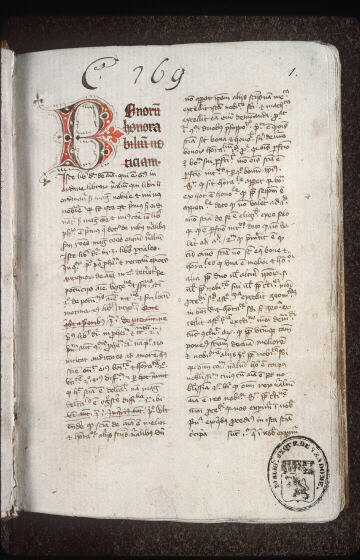
Page from a 14th century edition of De Anima


I read this article about Asperger's Syndrome in the NYT recently and was annoyed by its insistence that people misdiagnosed with Asperger's nevertheless suffer from "social disabilites." They're quiet, so something must be wrong with them ...

Articles like this make me appreciate how wonderfully free from excessive psychologizing classics usually manages to be. I wanted to delve a bit into what did pass for psychology in antiquity.

It seems that psychology from the classical period up through the 19th century is based on Aristotle (big surprise). For Aristotle (Peri psyches/ De Anima) the soul is inseparable from the body. The rational soul has a 'possible intellect,' a storage area of ideas essentially, and an 'agent intellect', which forms selected ideas into thoughts. This is a bit like the concept of mind espoused by one of my favorite Victorian detectives (and fittingly, one with considerable "social difficulties"):
I consider that a man's brain originally is like a little empty attic, and you have to stock it with such furniture as you choose. A fool takes in all the lumber of every sort that he comes across, so that the knowledge which might be useful to him gets crowded out, or at best is jumbled up with a lot of other things, so that he has a difficulty in laying his hands upon it.
-Sherlock Holmes, "A Study in Scarlet" 
photo credit  Pin It

Tuesday, March 13, 2012

Greek tragedy and class issues

"It starts out slowly
but still the strength of the gods
is trustworthy. And it punishes
those mortals who honor foolish arrogance
and those who, in the madness
of their opinions, do not extol things divine."
Euripides, Bacchae, tr. Stephen Esposito, 882-887


I used to think life experiences were responsible for my inability to go along with certain stereotypes common to my line of work. As in, I don't think people who didn't go to college are my inferiors or at a permanent disadvantage in life (except 'on paper'). Ditto for those who have children before 30, have served in the military, etc.

But I've been reading a lot of Greek tragedy lately. And I'm wondering if 10+ years of immersion in the classical world is responsible for this attitude as well. Now, tragedy was composed and performed by the elite (and the male). But if a civilization that was even more stratified than ours can put profound speeches and sentiments in the mouths of slaves, foreigners and women, surely we can take people as individuals and accept that there can be many routes to becoming a well-rounded, thoughtful person. Pin It

Saturday, March 10, 2012

A Fenian Grandchild


In a recent episode of Downton Abbey, Lady Cora tells Lord Robert that their youngest daughter is expecting, and he says something like, "Great, a Fenian grandchild."

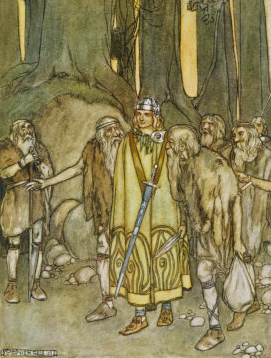
We were wondering exactly what that meant. It was meant to be sarcastic/mildly derogatory, but how? Lady Sibyl is married to an Irishman (horrors :)) and it seems the Fenian Brotherhood was an early precursor to the Irish Republican Brotherhood. The name is based on Fianna, the word for a small band of warriors in Celtic mythology.

The term is especially associated with Fionn Mac Cumhaill, the Irish name for Finn Mac Cool. In Lord Robert's time and apparently today as well, it is a derogatory term for Catholics and Irish nationalists.

I guess I must harbor a latent love of soap operas ... I watched season 1 of the series in 2 days on Netflix. I'm eagerly awaiting season 3. I'm also waiting impatiently for PBS to get through their interminable Dickens miniseries so I can see see season 2 of Sherlock.

photo credit Pin It

Tuesday, February 28, 2012

Classical themes in the 'Fablehaven' series


On a friend's recommendation I've made the Fablehaven books my escapist reading lately. There are five volumes in this YA fantasy series: Fablehaven, Rise of the Evening Star, Grip of the Shadow Plague, Secrets of the Dragon Sanctuary and Keys to the Demon Prison. I'm halfway through the third book. Actually, I've been reading them so quickly I didn't note the title of volume 3 until this moment.

They are set in a preserve for magical creatures, which provides some obvious classical references: minotaurs, satyrs (some of the best characters, actually), centaurs, dryads, naiads. I've just been having a little think about whether there are classical themes as well.

The series as a whole is about the struggle to keep the great demon prison Zzyzx from being opened. It really seems to me like a prison for evil supernatural beings has its roots in Tartarus, where the Titans and others were confined in classical mythology. Sure there are misbehaving entities in Norse mythology, like Loki and Fenrir, but they are not confined together in a specific place (that I am aware of).

The series also features teenagers saving humanity when the adults fail: Seth and Kendra, grandchildren of the Fablehaven caretakers. The husband and I have mocked the Harry Potter books for this many times (while devouring each new book and movie, naturally). I've had some fun comparing Seth to Achilles, the original impulsive teenage hero who learns restraint at a terrible cost. Seth's immunity to magical fear is a bit like the Phthian hero's "heart of iron."

UPDATE: I just started book 4 and there's a charming, personable witch who attracts mortal lovers by trickery. An adventure series that's reminiscent of the Theogony, the Iliad and the Odyssey? I'll take it. Pin It

Thursday, February 16, 2012

List-making: it's not just for Mycenaeans anymore

Although I found its additive style a little annoying (ironically), I appreciated this article on the history of the list. If nothing else, it has inspired me to stop apologizing for Linear B ("Yes, there was written Greek in the Mycenaean period, but unfortunately it's only lists of supplies and livestock.")
According to Robert Belknap in his book The List: The Uses and Pleasures of Cataloguing—a study of literary lists, particularly in the work of four American Renaissance authors—lists of sequential signs appeared as early as 3,200 B.C.E. Used as a means of accounting and record keeping, they signified an early form of communication that would evolve into written language. If this is true, then Eco is right: the list is the origin of culture.
List-making is also at the heart of traditional poetry, which often begins with genealogies. I frequently downplay the lists that occur in Homer and Hesiod in an effort to make those authors seem more accessible. I briefly mention the list's importance as a test of the bard's memory and as a way of including various parts of the audience (as with the Catalogue of Ships). But now maybe we will look deeper at how such poetry is in some sense an elaboration on a list (of gods or heroes).

Pin It

Tuesday, February 14, 2012

Ancient Greece and Us

Michael Scott ("The Question of Life in the Ancient World") touches on some of the same themes as Mary Beard's "Do the Classics Have a Future?". A taste:
[M]ost newspaper articles either start or round up their coverage of the modern situation with some expression of nostalgic comparison to the glory days of ancient Greece. But to what exactly are we referring? Just what was life like in ancient Greece?
It's peripheral to his overall point, but I love that he's noticed this tendency of articles on the economic crisis to make token references to ancient Greek. It's particularly irritating to someone like me who relies on Google Alerts for blogging material and has limited interest (and expertise) in modern economics.

I came to grad school really excited about the 'relevance' of classics to the modern world, something that now makes me wince a little bit. Undergraduate programs often flog the relevance idea, understandably, as a way of attracting and keeping students. And of course I deeply believe that the study of antiquity is relevant to modern life. But there's discontinuity as well as continuity, which is why every single article about the economic crisis doesn't need to quote Solon, or refer to Athens as the birthplace of democracy.

Like Beard, Scott discusses the ongoing construction of 'the ancient world' in our minds:
In part because so little was known about the realities of ancient Greece in the 15th-17th centuries, the articulation of ancient Greece as an ideal rested upon modern re-imaginings of the pictures conjured up by ancient literature, populated with increasing numbers of pieces of ancient ‘art’ and architecture as they came to light, which were then ‘fitted in’ to that model. 
I spoke to an English class last month that was studying the Iliad, and I could tell it blew their minds a little bit to learn that until relatively recently, the Mycenaean world was regarded as quasi-fictional. Fascinating stuff.

H/T rogueclassicism Pin It

Sunday, January 22, 2012

"In the depths of digital libraries lie dead Iliads."


The "Siege of the Iliad" over at the Chronicle is a fun, fast read. I appreciate its tight focus on the issue of translation style -- it's very easy (very easy) to become pedantic or get bogged down in scholarly minutiae when talking about Homer.

But the Iliad appealing mainly to fighters or manly men? Nah. It's actually striking how many prominent English language Homerists are women. And Simone Weil's "The Iliad or the Poem of Force" makes a cogent (and passionate) argument for viewing Homer's poem as anti-war.

I do wonder why more women haven't translated Homer. It may be a perception issue, where there's a concern that such a translation would be taken less seriously. It seems odd, when nearly every other Greek genre has been translated by both men and women, but gender stereotypes can be odd like that.

image credit Pin It

Saturday, January 14, 2012

"Hour-long lectures on the color of Dido's hair"

Lauren Davis's piece on the survival of our pop culture is lovely and imaginative. But there's a more important reason I liked it: it explains why my classical studies students prefer Homer to Vergil:

Today... the Aeneid is relegated to upper-level Latin classes, while middle schoolers and high schoolers get the Greeks' mythical side of the story with Homer's Iliad and Odyssey. So why do Hector and Achilles get a starring role in English class (and, consequently, big box office movies) while Aeneas and Dido don't? A Latin teacher once explained to me that when she tried to teach Vergil's poem in English, she had very little to say. The Aeneid is one of the great works of Western literature, but appreciating it depends heavily on understanding the language in which it was written: Vergil's word choices, his syntax, even the number of times he uses certain words to describe Dido's hair. (I had a Latin teacher who could deliver hour-long lectures on the color of Dido's hair.)
Pin It

Thursday, December 29, 2011

"A cultural language ... in dialogue with the idea of antiquity"

If you haven't already, check out Mary Beard's "Do the Classics Have a Future?" over at the New York Review of Books.

A taste:
The truth is that the classics are by definition in decline; even in what we now call the “Renaissance,” the humanists were not celebrating the “rebirth” of the classics; rather like Harrison’s “trackers,” they were for the most part engaged in a desperate last-ditch attempt to save the fleeting and fragile traces of the classics from oblivion. There has been no generation since at least the second century AD that has imagined that it was fostering the classical tradition better than its predecessors. But there is of course an up-side here. The sense of imminent loss, the perennial fear that we might just be on the verge of losing the classics entirely, is one very important thing that gives them—whether in professional study or creative reengagement—the energy and edginess that I think they still have.
Pin It