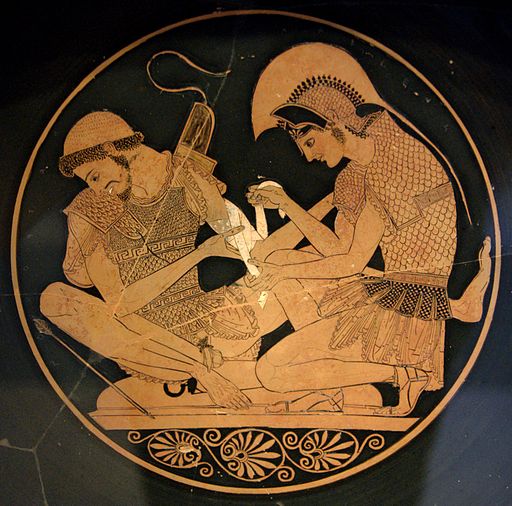
Showing posts with label the Iliad. Show all posts

Wednesday, January 23, 2013

Valuing life in antiquity


From the comments to a PhDiva post on post-traumatic stress disorder in antiquity:
I sometimes wonder if modern scholars think that ancient people just didn't value their lives as much as we do since they did not shrink from casualties as high as 50,000 in a single military engagement or investment of an enemy city. But if you've ever looked at some of the poignant grave goods found in ancient burials or studied the reliefs on ancient funerary monuments I think you will conclude that we are only separated by time not by our shared human nature.
I think this is spot-on. I'm reminded of one of my favorite classical essays, Simone Weil's The Iliad or the Poem of Force:
The bitterness of [violent death] is offered us absolutely undiluted [in the Iliad]. No comforting fiction intervenes; no consoling prospect of immortality; and on the hero's head no washed-out halo of patriotism descends….
Still more poignant -- so painful is the contrast -- is the sudden evocation, as quickly rubbed out, of another world: the far-away, precarious, touching world of peace … [4]
image credit  Pin It

Friday, November 23, 2012

Is the Iliad campy?


After I saw Skyfall last weekend, the spouse and I discussed the inherent campiness of action movies. Action movies are supposed to have become more thoughtful on the heels of the Bourne Identity series, but they are still full of heroes who think nothing of chasing a villain over rooftops on a motorbike, then getting shot, then fighting said villain on top of a moving train.

Is there an inherent campiness to such unrealistic deeds? And does Greek lit get to do an end-run around this by making heroes the sons of gods and goddesses? I understand campiness to be an amusing lack of realism. In a Greek context, of course, amusing and realism may have looked very different than they do to us.

It's accepted that certain parts of Homer's poem are meant to be funny, mostly passages involving gods behaving badly. In fact the gods are probably acknowledged to be the campiest part of the Iliad. But are the human characters, particularly Achilles, ever campy? As this NY Times blogpost recently argued, we find sincerity without irony amusing; did the Greeks? 

"I hate that man like the gates of hell who hides one thing in his heart and says another" (Il. 9.312-313)
As far as unrealistic deeds of arms, such as the slaying half the Trojan army in the Scamander river, followed by a very credible effort to conquer the river itself, the Greeks do have an advantage in their tradition of hemitheoi, half-divine heroes. We can't say, "but a person couldn't do that …" because in an important sense Achilles is not a person, or not just a person. As far as I can tell, Achilles' seriousness is taken seriously throughout the Iliad, when he withdraws from battle, when he mourns Patroclus, and even in the Odyssey when he rails against death (the hero who chose an early, glorious death with full knowledge).

Still, there is a reason Odysseus and his poem are more popular today, as a subject of scholarship and as a cultural touchstone. Whatever the original audience's stance towards Achilles may have been, the possibility of ironic distance helps us deal with his implacable, uncomfortable forthrightness in our more 'nuanced' age. As the NYT piece pointed out, we modern ironists mock what we secretly long for:

But Y2K came and went without disaster. We were hopeful throughout the ’90s, but hope is such a vulnerable emotion; we needed a self-defense mechanism, for every generation has one. For Gen Xers, it was a kind of diligent apathy. We actively did not care. Our archetype was the slacker who slouched through life in plaid flannel, alone in his room, misunderstood. And when we were bored with not caring, we were vaguely angry and melancholic, eating anti-depressants like they were candy.


Pin It

Tuesday, October 30, 2012

"Good," "Noble" and Occasionally "Large"


Wonderful, funny NPR article on the Iliad vs. Adele Geras' young adult novel Troy:
The Iliad is probably a better poem for never describing the size of Helen's breasts or the exact shade of Paris' hair (a "spun gold," if you believe Geras). But there is something immensely satisfying about the unabashed sentimentalism and lush prose of Geras's Troy after the cryptic sparsity of the original, in which the city falls only by implication, when its hero, Hector, dies. We never see it go down, which is both masterful and frustrating. But Troy provides us with flames, destruction and trysts among the ruins.
The novel follows various Trojan women during the siege and destruction of the city and features several love triangles, an unwanted pregnancy, and sometimes shockingly bad prose ("There's a fire burning in my body, and only you can put it out"). Xanthe and Marpessa are a pair of sisters in love with the same boy, the unsubtly named Alastor (Greek for "vengeful spirit"), and together they survive the deaths of Hector, Achilles, Priam and, eventually, the destruction of the city. 
Pin It

Sunday, October 14, 2012

Would you have a beer with Agamemnon?


As I mentioned last time, I've been re-reading The Lonely American and thinking about the American myth of virtuous independence that the authors criticize. 

Rather than focusing on myths detrimental to ancient life, as originally planned, I've decided to follow up with a post on ancient (elite) people and social connections.

Now, I love the Greeks. But it seems to me that the elite Greeks were either overly dependent on family connections, or quarrelsome and backstabbing within their social group.

For example, Agamemnon, as far as I can recall, has no close friends apart from his brother, for whom he harbors an almost smothering affection. Witness his total freakout when Menelaus is slightly wounded in _Iliad_ book 4:

When King Agamemnon saw the blood flowing from the wound he was afraid, and so was brave Menelaus himself till he saw that the barbs of the arrow and the thread that bound the arrow-head to the shaft were still outside the wound. Then he took heart, but Agamemnon heaved a deep sigh as he held Menelaus's hand in his own, and his comrades made moan in concert. "Dear brother," he cried, "I have been the death of you in pledging this covenant and letting you come forward as our champion. ….how, Menelaus, shall I mourn you, if it be your lot now to die? I should return to Argos as a by-word, for the Achaeans will at once go home. We shall leave Priam and the Trojans the glory of still keeping Helen, and the earth will rot your bones as you lie here at Troy with your purpose not fulfilled. Then shall some braggart Trojan leap upon your tomb and say, 'Ever thus may Agamemnon wreak his vengeance; he brought his army in vain; he is gone home to his own land with empty ships, and has left Menelaus behind him.' Thus will one of them say, and may the earth then swallow me."
The symposium ("drinking-together") immediately springs to mind as an example of a later, civilized friendship circle. But there's more to it than intellectual companionship and good times. David Konstan identifies several proverbs that hint at strife and betrayal in the symposium: "He who does not betray a man who is his friend has great honor among mortals and gods, in my judgment"; "If only it were possible to know without being deceived about each man who is a friend what he is like, cutting open his chest, looking into his heart, and locking it up again" (45).
I think the Romans may have done better, but I may be getting that impression simply because Cicero writes so eloquently and frequently about the joys of friendship. That's another post.
Pin It

Monday, July 2, 2012

Greek epic and movie palaces

The Chicago Theatre, a 'movie palace'
Yesterday I was looking for theaters with 'crying rooms,' so I could go to the movies with my spouse. Right now we have an "I go one day, you go the next, then we discuss the movie" arrangement.

Crying rooms are rooms where you can take your fussy child and finish watching the movie without disturbing anyone else. Only older theaters, aka "movie palaces," have them. Movie palaces, many built during the Great Depression, were super-fancy theaters designed to make average people feel like royalty and allow them to escape their circumstances for a little while.

The movie palaces' fantasy element struck me as quite similar to the escapist overtones of early Greek epic. Early Greek epic was composed during the Dark Ages (quite as grim as the Great Depression) for a sub-elite audience. Hence the poems' grandeur, tragedy and even their mania for visual description. Stories that are too close to your everyday life are useless as a way to "escape", but you need to be able to picture what that alternative, escapist world looks like, whether it's a medieval palace or the treasure room of a Mycenaean king.

I get a kick out of imagining that nebulous group of people, the 'original audience of the Iliad,' as a bunch of downtrodden 1930s office workers going to the movies. But maybe that's just me.

image credit Pin It

Thursday, June 21, 2012

The Song of Achilles by Madeline Miller


Madeline Miller's novel is an engaging and quite moving version of the life of Achilles and Patroclus, whom she presents as lovers.

I understand how some Amazon reviews have a problem with the way battle scenes are presented. But this is not a book about the reality of war. That is made clear fairly early, when the young Achilles does not practice fighting in front of anyone else. 
"My mother has forbidden it. Because of the prophecy.""What prophecy?" …."That I will be the best warrior of my generation."It sounded like something a young child would claim, in make-believe. But he said it as simply as if he was giving his name. (p. 38)
 Later, Patroclus describes Achilles' fighting as something from which Achilles himself is quite detached ("'They could not get close enough to touch me,' he said. There was a sort of wondering triumph in his voice." [p. 222]). The Trojan war has such a heavy admixture of the supernatural that realistic battle scenes would be out of place.

The heart of Miller's story is the time the boys spend with Chiron on Mount Pelion. Going to Pelion is the first substantial risk Patroclus takes for Achilles' sake. His mother Thetis believes Patroclus is too lowborn and too ordinary to be her son's companion, and has expressly forbidden that he accompany Achilles. After a trial period Chiron allows him to stay anyway. Warfare is (perhaps surprisingly) not a focus of Chiron's teaching. Rather, the boys learn music, healing, survival skills and ethics. When the couple is at Troy and living under the shadow of Achilles' imminent death Patroclus frequently recalls conversations they had or skills they learned on Pelion.
Chiron had once said that nations were the most foolish of mortal inventions. "No man is worth more than another, wherever he is from."
"But what if he is your friend?" Achilles had asked him, feet kicked up on the wall of the rose-quartz cave. "Or your brother? Should you treat him the same as a stranger?" (p. 298)
In conclusion, Miller's Patroclus may well be more sensitive and articulate than were most Bronze Age Greek men, and the experience of average people in war is given rather short shrift. But her observant and emotionally astute hero gives us a marvelously detailed portrait of Homeric society, the imagined prehistory of Greece.


image credit
Pin It

Monday, June 4, 2012

'My secret novel'


Madeline Miller has a delightful article up here about how she came to write The Song of Achilles despite her early distaste for classical adaptations. I hope her SO revised his opinion:
When I finished the first chapter, I made the mistake of telling my classicist boyfriend. He accused me of writing “Homeric fan fiction”.“Do you really think that you could ever be as good as Homer?” he asked.I twisted my hands, guiltily. Of course I didn’t. “But maybe the piece could still be good, just on its own?”
Pin It

Sunday, April 22, 2012

Don't make me use this: Odysseus to Thersites


From Stephen Mitchell's Iliad (2.244-248):
"But I swear to you now -- and if I don't do what I say,
may somebody come and cut my head from my shoulders --
that if I ever catch you spewing such nonsense again
I will strip you naked and whip your a** out of here
and send you back to the ships, howling and bawling."
image credit  Pin It

Thursday, April 19, 2012

Classical myth and the Hunger Games


I planned to base a mythology lesson on The Hunger Games, although ultimately it did not fit into the schedule. Although I enjoyed the book, and thought there were a lot of general parallels with the classical world, the movie really brought the classical parallels into focus for me.

1. Theseus and the Minotaur
This is the source mentioned on Suzanne Collins's Wikipedia page. I have to say, I mocked Athens quite a bit in class this semester (Hercules murdered his whole family! But then Theseus takes him to Athens where anything can be fixed!). So I have a hard time getting really into this as a source myth. I'm not saying that THG is not a worthy modern interpretation, just that the comparison doesn't fire my imagination.

2. Antigone
This is a parallel the movie brought into focus quite beautifully for me. Covering Rue with flowers and gesturing accomplished in a couple of minutes much of what it took Sophocles hundreds of lines (and one really annoying heroine) to do.

3. The Iliad
Something about the luminous lighting in President Snow's garden (and his revolting detachment from the Games) really suggested the Greek gods to me. Maybe this is the approach the next movie about Greece should take -- skip the togas and just get a really scary white-haired man in a rose garden to play Zeus. Pin It

College graduation in the Bronze Age


Cool quote from the intro to Stephen Mitchell's Iliad:
"Here, amid all the sorrow and concern and deep husbandly love, in what both these admirable people sense may be their final meeting, at the climax of a prayer Hector must know will never be fulfilled, is the image of a mother rejoicing at her son's return from battle with the bloody armor of the enemy he has just killed, as if she were watching him in his robe and mortarboard graduating from college."
image credit  Pin It

Tuesday, April 17, 2012

Achilles the vampire?


Last week's myth class perked up briefly when, in a sudden fit of inspiration (desperation?), I compared Achilles to a vampire. Prior to the poems' conclusion, he stops needing to eat and reaches almost demonic heights of rage, so I said that he was "almost an undead figure." The students seemed quite taken with this idea.

No doubt if I rewrote the poem to include some zombies and vampires (a la Jane Austen), some of them would actually read it.* Never mind that the work's humanity is supposed to be the point ...

*Emboldened by the fact that I'd already given the evals, I asked recently if anyone had actually done the reading. (This was after asking several factual questions about the text that no one would answer.) The response was, shall we say, less than heartening.

photo credit Pin It

Thursday, March 29, 2012

"The Unbearable Truth of War"

This review (of the one-man show An Iliad) won me over immediately by its references to Simone Weil:

While translations abound, dramatizations of the Iliad are fairly uncommon. Of course the poem has inspired countless plays—Aeschylus, for instance, called his tragedies “scraps from Homer’s banquet.” But these typically focus on a single episode, like the Greeks’ efforts to persuade Achilles to return to battle in Book 9. The entirety of Homer’s text runs to over 15,600 lines and would take about 24 hours to recite from beginning to end; it also has hundreds of characters—men, women, gods, demigods, a crying baby, and two immortal, talking horses, among others.
Pin It

Friday, October 14, 2011

The Iliad and 'Drive'

While my mom was here my husband and I got to go to the movies (twice! by ourselves!). Moneyball was boring, although I could see how it got its good movie vibes: there was no cheap emotion, and all the scenes advanced the plot. It maybe could have used a little cheap emotion. But I digress.

Drive was haunting. Looking at its Wikipedia entry, I see that it was intended as a modern fairy tale. But what it really reminds me of is Homer's Iliad. Thinking about my novel, I've been trying to imagine marriage relationships in Homeric Greece. Drive recreated in a modern setting that vast divide between men's and women's lives that is especially characteristic of the Iliad.


The scene that epitomizes this, of course, is the elevator sequence, where the Driver kisses Irene for the first and last time, moments before he kills the third passenger in the elevator. He moves her aside, kisses her with his full attention, and then throws himself whole-heartedly into murdering the mob assassin riding the elevator with them.


Throughout the movie, there is emphasis on Irene's separation from the violence and killing. Albert Brooks tells the Driver that if he gives back the money, "the girl is off the map." The violence and killing itself resembles violent incidents in the Iliad: we are given enough background to feel pity, but at the same time the murders are carried out quite dispassionately.


I'm not saying that the movie 'alludes' to the Iliad. It seems to express some kind of man-woman drama similar to that which inspired Homer's poem.


Pin It