Saturday, December 22, 2012

'Sherlock' and the paths of song


A couple of shows I enjoy, 'Sherlock' and 'Alphas', employ these weird floating visualizations of the internet. 'Alphas', a show about mutant counter-terrorism agents, has a character whose only job is to use his ability to 'see' data streams. 'Sherlock' uses the technique in a scene where the irascible detective demands privacy so he can go to his 'mind palace', a sort of mental Google.

I wondered why this interested me so much, and then I remembered a passage from Homer: the Poetry of the Past. Here's a taste:

The way [oimai, "paths"] is used in early Greek indicates that it was a … term for the … themes of epic…. Apparently… the relative fixity and stability of themes was figured in Homeric language by describing them as if they were tracks cut into some landscape. The process of singing was thus a progress, and Hesiod could sum up his election as a poet by saying that the Heliconian muses "made me walk upon [the path] of singing." To proceed from one topic of heroic song to another was to "move along" the paths of song, expressed in another apparently technical word, _metabaino_, to pass from one place to another. (42-43)

Travel was antiquity's metaphor for mentally cataloguing information, whereas disembodied text and images seem to be our way of envisioning this process. Our minds really are reshaped by changing methods of communication.
Pin It

Saturday, December 15, 2012

'Sappho' by Peggy Glanville-Hicks


Enjoy this excerpt from the opera 'Sappho' by the Australian composer Peggy Glanville-Hicks. The work, completed in 1963, had it debut just this year. The Australian has a biography of the composer. 
Pin It

Monday, December 10, 2012

Are those knucklebones in your pocket, or are you just happy to see me?


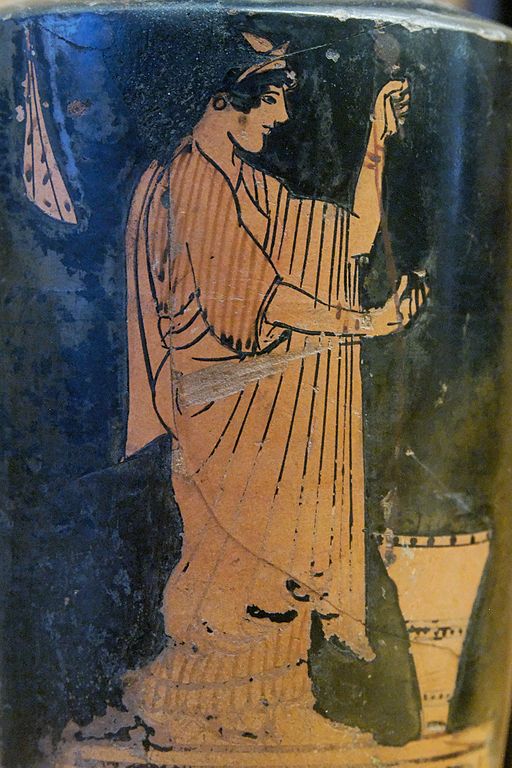
I try to find the funny in academic research whenever I can, and I was amused to come across the "spinning hetaira" this week. The spinning hetaira is to be a woman on Greek vases, who is approached by a man or boy holding a pouch as she spins wool. It is presumed that the pouch holds money with which to pay for the 'hetaira''s services. A few problems with this, as argued by Gloria Ferrari (in Figures of Speech: Men and Maidens in Ancient Greece): 1) The women are not dressed as hetairai 2) It was part of a hetaira's mystique to avoid dealing directly with money 3) Identical pouches are identified as holding game pieces, not money, in other contexts.

But what's really enjoyable is the way Ferrari gets to poke gentle fun at the attitude that all spinning women in the vicinity of bags are courtesans:
"A prim figure (fig. 5) enthroned and spinning, is labeled the madam of a brothel. A scene of men and boys approaching, bag in hand, a figure wrapped like a mummy and holding a mirror can be described as "a hetaira seated in the porch of what is surely a brothel." (Fig. 6). A sense of the grotesque makes a fugitive appearance in Keul's remarks on this vase: Is the whole family on an excursion to the neighborhood whorehouse? Surely not, even in classical Athens" (13)." 
It's all in the adjectives: prim figure, fugitive appearance, etc. Funny stuff (for academic writing anyway).


image credit Pin It

Thursday, November 29, 2012

"Some people."


From mental multivitamin, a perfect example of how academia can dampen the imagination (for example, the ability to imagine a humorous class comment)…
The week we were to discuss Tess, he opened as always, with a leading question about our response to the novel. For whatever reason, the class was silent, almost guiltily so. Didn't they read it? I wondered. He asked again. The absence of pseudo-erudition became most uncomfortable. We can sit here all night, people, the professor sighed.
Well, I offered with a light laugh and a glance around the room, that Angel is rather a slow one, eh? Who knew he'd be such a pill?
I was being a smartass. The lone journalism major among this set of English prof wannabes, I turned in papers according to conventional standards -- double-spaced, one-inch margins -- and I actually read the books. Every book. Every page. Of course I realized that Angel was a creature of the conventions and limitations of his time, but wasn't it fun to call him out on his double standards from the relative comfort and social tolerance of the late 1980s?
I guess not.
The professor spent the next two hours using my remark to demonstrate how utterly "some people" missed the point of the novel, how "limited" readers are when they can only frame their responses from their own experience, and so on. And my classmates? Who hadn't even read the feckin' novel? What a bunch of sycophants they turned out to be: Oh, yes, professor. Some people. So limited. How foolish.  

That's a prof who's pretty sure of himself; most of the classics proffies I know would be filled with gratitude to realize that someone had done the reading that day ... and was willing to talk about it! Pin It

Tuesday, November 27, 2012

Funny


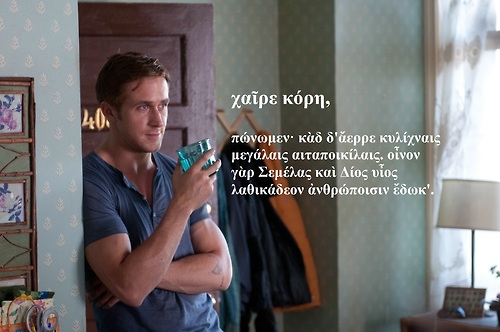
Classics Ryan Gosling

image credit Pin It

Friday, November 23, 2012

Is the Iliad campy?


After I saw Skyfall last weekend, the spouse and I discussed the inherent campiness of action movies. Action movies are supposed to have become more thoughtful on the heels of the Bourne Identity series, but they are still full of heroes who think nothing of chasing a villain over rooftops on a motorbike, then getting shot, then fighting said villain on top of a moving train.

Is there an inherent campiness to such unrealistic deeds? And does Greek lit get to do an end-run around this by making heroes the sons of gods and goddesses? I understand campiness to be an amusing lack of realism. In a Greek context, of course, amusing and realism may have looked very different than they do to us.

It's accepted that certain parts of Homer's poem are meant to be funny, mostly passages involving gods behaving badly. In fact the gods are probably acknowledged to be the campiest part of the Iliad. But are the human characters, particularly Achilles, ever campy? As this NY Times blogpost recently argued, we find sincerity without irony amusing; did the Greeks? 

"I hate that man like the gates of hell who hides one thing in his heart and says another" (Il. 9.312-313)
As far as unrealistic deeds of arms, such as the slaying half the Trojan army in the Scamander river, followed by a very credible effort to conquer the river itself, the Greeks do have an advantage in their tradition of hemitheoi, half-divine heroes. We can't say, "but a person couldn't do that …" because in an important sense Achilles is not a person, or not just a person. As far as I can tell, Achilles' seriousness is taken seriously throughout the Iliad, when he withdraws from battle, when he mourns Patroclus, and even in the Odyssey when he rails against death (the hero who chose an early, glorious death with full knowledge).

Still, there is a reason Odysseus and his poem are more popular today, as a subject of scholarship and as a cultural touchstone. Whatever the original audience's stance towards Achilles may have been, the possibility of ironic distance helps us deal with his implacable, uncomfortable forthrightness in our more 'nuanced' age. As the NYT piece pointed out, we modern ironists mock what we secretly long for:

But Y2K came and went without disaster. We were hopeful throughout the ’90s, but hope is such a vulnerable emotion; we needed a self-defense mechanism, for every generation has one. For Gen Xers, it was a kind of diligent apathy. We actively did not care. Our archetype was the slacker who slouched through life in plaid flannel, alone in his room, misunderstood. And when we were bored with not caring, we were vaguely angry and melancholic, eating anti-depressants like they were candy.


Pin It

Thursday, November 15, 2012

'Achilles had only 2 heels'


A little knowledge of myth can be a dangerous thing, as this guest blog at Scientific American demonstrates:

When I think about [cancer] research, two other Greek legends come to mind: The legend of Sisyphus and the Odyssey. Every day, Sisyphus rolled a rock up a mountain and then had to watch how it would roll back down again. This was his punishment decreed by the Greek gods. It reminds me of a lot of experiments that we scientists perform. When we feel that we are getting close solving a scientific problem we sometimes realize that we have to start all over again. Similarly, Odysseus’ long and exhausting journey is also a metaphor that appropriately characterizes a lot of real-life scientific research. Odysseus did not know if and when he would ever reach his destination, and this is how many of us conduct our research.I googled “Odyssey” and “cancer” to see if I could find news articles that allude to the scientific Odyssey of cancer research. To my surprise, I did find a number of articles, but these were not descriptions of scientific “Odysseys”. They were reports of cancer patients who described how they had undergone numerous different cancer treatments, often with little improvement. I realize that it is easier to market scientific ideas with a simplistic Achilles metaphor than to point out that science is long-winded and at times disorienting journey, similar to the Odyssey. 
image credit 

Pin It