Friday, March 15, 2013

Medieval People Doing Things


Elizabeth Chadwick, one of my favorite medieval fiction writers, blogged this video as one of her 'Friday Favorites' last week:


This is the kind of thing that is going to be roundly mocked by those without a soft spot for the middle ages. I might have liked a few more examples of illuminations from the manuscript, but there's still much to enjoy. I love the low-key, intensely practical daily activities and the 'clutter with a purpose' in the inside rooms: i.e., I have all this crap on a shelf because I'm making all my family's clothes or creating a beautiful book, not because I'm a hoarder.

Plus, toddlers love it. Lots of animals.


Pin It

Wednesday, March 13, 2013

I wish I could lecture like this: Zeus Grants Stupid Wishes


If you love myth, or just wish you could use more colorful language while teaching, check out Zeus Grants Stupid Wishes. A taste:

"… for a long, LONG time, the difference between a good story and a bad story was whether a bard could memorize it well enough to not get eviscerated by a mead hall full of drunken barbarians."

Discussing Cronus:

"So the moral of the story
is that if you are not ready to be a father
consider all of your options
before skipping directly to cannibalism."

I'm still reading it, so I'll no doubt have more quotes to share.

Pin It

Tuesday, March 5, 2013

'Sleeping Eros' and Educational Rigor


The spouse and I have been discussing whether 'less is more' in teaching, and if so, whether we should push back against that or embrace it. I had a classics-in-translation course I taught several times, and the year I got very (excessively?) rigorous with it was the year I got the worst set of final papers. Other years, when I occasionally let class out early and gaged readings by how much I thought they could absorb at one time, rather than how much they should, I had much better results.

My philosophy kind of boils down to this: pandering and what I call 'gumball machine pedagogy' are both counterproductive. Gumball pedagogy assumes that if you put certain exercises or information into students, identical results pop out. If they don't it's the teacher's fault for not putting in the right thing. I regret to say that senior faculty are particularly apt to inflict this attitude on junior faculty. If senior faculty don't get the results they desire, there are much more *complex* forces at work …

All of this came to mind while reading the NYT review of the Met's show 'Sleeping Eros.' The review begins "A shortage of cash sometimes proves beneficial," and goes on to extol the virtues of a small, relatively simple exhibition in which drawing exclusively from its own collection forces the museum to make unusual juxtapositions (like combining sculpture from antiquity and the Renaissance). Amy Dacyczyn calls it "creative deprivation," as in deprivation that enhances creativity. We might also think of it as the simple lack of overstimulation, a rare condition indeed in the days of google and "more is better" educational philosophy.

Pin It

Tuesday, February 12, 2013

Review: Goddess of Yesterday


Goddess of Yesterday follows Anaxandra, daughter of a minor chieftain in Mycenaean Greece, sent as hostage to the king of Siphnos. When Siphnos is sacked she ends up in the care of Menelaus of Sparta, witnessing the theft of Helen and the start of the Trojan war.

Cooney's novel succeeds where other fiction about the Bronze Age (like the execrable Gates of Fire) fails, largely because of the naive narrator. A girl raised in isolation, Anaxandra has no pretensions to sophistication or anachronistic open-mindedness. Observing Helen of Troy and her family from a child's perspective, she feels the eerie attraction of the queen's beauty and the repulsiveness of her selfish heart, but does not try to rationalize away the contrast as an adult would. 

Anaxandra's youth also leads her to accept other Mycenaean customs such as the sacrifice of animals and humans in a natural manner. She imagines Agamemnon was shocked when the gods ordered him to "make his own daughter holy," but there is no pretense that he should have tried to second-guess fate. The romance between the heroine and the neutral king Evenus is innocent without being Victorian, and sparked by the 'new' custom of horseback riding.

Pin It

Sunday, February 10, 2013

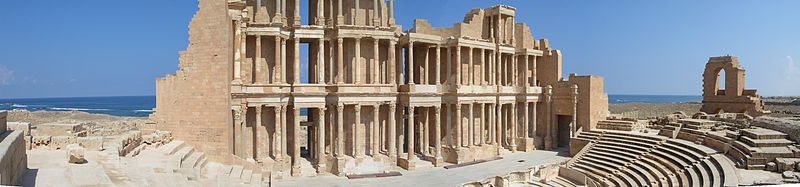
The Roman theater of Sabratha

It seems that Libya is home to an impressive collection of Roman ruins, which officially didn't exist under Quadafi's regime. I admit to finding 'other' Roman ruins (as in, not the Roman forum) a bit boring, even very extensive ones that have been more or less lost and rediscovered:

Leptis Magna, the arch of Septimius Severus (Image credit)
But I think even non-archaeologists might find themeselves captivated by the theater at Sabratha, where a three-story architectural backdrop still stands:

Image credit


I would love to know if this was a standard feature of Roman theaters. Perhaps we don't even know for sure, if theater backdrops are not preserved elsewhere. But it does change the way I imagine the theater scenes from Ars Amatoria, or the performances at the Theater of Pompey where Caesar was assassinated (in an adjoining meeting room).

Pin It

Wednesday, January 23, 2013

Valuing life in antiquity


From the comments to a PhDiva post on post-traumatic stress disorder in antiquity:
I sometimes wonder if modern scholars think that ancient people just didn't value their lives as much as we do since they did not shrink from casualties as high as 50,000 in a single military engagement or investment of an enemy city. But if you've ever looked at some of the poignant grave goods found in ancient burials or studied the reliefs on ancient funerary monuments I think you will conclude that we are only separated by time not by our shared human nature.
I think this is spot-on. I'm reminded of one of my favorite classical essays, Simone Weil's The Iliad or the Poem of Force:
The bitterness of [violent death] is offered us absolutely undiluted [in the Iliad]. No comforting fiction intervenes; no consoling prospect of immortality; and on the hero's head no washed-out halo of patriotism descends….
Still more poignant -- so painful is the contrast -- is the sudden evocation, as quickly rubbed out, of another world: the far-away, precarious, touching world of peace … [4]
image credit  Pin It

Sunday, January 20, 2013

'I can't bear the movie _300_ because I used to excavate in Sparta'

'Where are the other 299?'

Just discovered the site Dorothy King's PhDiva. It's an absorbing mix of commentary about the author's projects (King published The Elgin Marbles in 2006), personal musings  and delightfully quirky pieces by Sarah Bond (a co-blogger?), such as the recent 'Revolutionary Materials: Furniture and Civil Uprisings in Antiquity'.)

I've added it to the sidebar. Enjoy!

*Quote is from King's 'about' page.


Pin It