Showing posts with label Greek literature. Show all posts

Monday, November 7, 2011

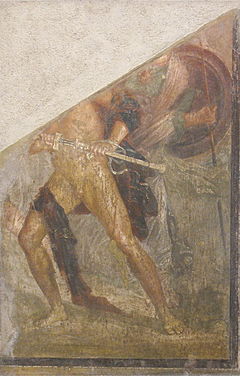
'The World of Odysseus'

via Wikimedia Commons
Published in 1965 (rev. ed.), before the footnote revolution, The World of Odysseus is wonderfully clear and straightforward. Of course, some of what it says is (according to modern scholarship) exaggerated or irrelevant. For example, Finley is at pains to argue that the Greeks were not "primitive," and the scholar in me wants to know 1) what does he mean by primitive and 2) what does it matter?

Denial that the Greeks were 'primitive' is often an attempt to place Homeric epic apart and above the then-emergent field of comparative oral traditions. (Basically, the idea that you can learn about archaic Greek epic -- or any traditional epic -- by comparing it with epic traditions from other cultures.) Finley is fair-minded about this, according to his lights. In his appendix "The World of Odysseus Revisited," he argues that the Homeric-length poem recorded by the Slavic bard Avdo Medjedovic is inferior in quality to the Odyssey but that the methodology of oral tradition is still valid (143).

It is a great pleasure to read a book about the Odyssey and about those whose experiences shaped it (rather than a book about the other books about the Odyssey, which is how I would describe many more recent works in this field). The chapters on "Wealth and Labour," and "Household, Kin and Community" deal in a measured way with topics that are frequently underrepresented in classical scholarship. More recent works that covers these topics are often hijacked by trendy subfields, but Finley manages to cover them thoroughly and unemotionally, as far as I can tell. In "Wealth and Labor," his argument that the worst-off person was not a slave but a thes, an unattached person, was particularly cogent and striking (57ff). In "Household, Kin and Community" he vividly describes a world where almost none of a household's business had public relevance unless the head of household chose to make it so. His point is well taken since, with Homer as the foundation of Greek literature, classicists are sometimes tempted to fit 'the world of Odysseus' into the mold of a classical polis.

The World of Odysseus would be an excellent introduction to the background of the Iliad and Odyssey. It is also (as is pretty well apparent in my review) a great refresher for anyone already acquainted with the poems who is worn out by the tendentiousness of much current scholarship.

Pin It

Wednesday, October 26, 2011

Hello Greek, I've missed you

I have an article that's almost ready to go (they always are, aren't they?), except for some Greek texts that need to be formatted in some particularly picky and annoying ways. I was reading one over just now, expecting to continue to be bored and annoyed, but instead the sound of the Greek gave me my first bit of Classics-related joy in several days.

I thought, "I've missed you, Greek."

I have thought before that the sense of professional disconnection I sometimes experience relates to spending 90% of my time teaching a language I have little intellectual interest in, namely Latin. That seems harsh, and I tend to speak hyperbolically about these things. I'm happy that Latin has paid my bills for the last half-decade. When I hear something interesting about Latin I think, "oh, that's nice," whereas I love the sound of Greek, its mysterious and fluid sound-changes, and its literature whose original and profoundly situational performance contexts we can often only guess at.

I guess I have Steve Jobs to thank, as corny as that is. I used to spend the entire early morning preparing for my Latin class, and then I read something he said, about if this was the last day of your life, would you want to spend it the way you were planning to do?

And I thought, I'm done neglecting my first and best-loved foreign language in favor of what (right now) pays the bills.
Pin It

Friday, October 21, 2011

Stephen Mitchell's Iliad and the college classroom

I enjoyed Maclean.ca's interview with Stephen Mitchell, author of a new and apparently very striking translation of the Iliad. The line he translates using "son of a bitch" has come up frequently in coverage of the volume's release. His explanation in this interview resonated with me:
via Wikimedia Commons
Q: In your translation Achilles responds, “Don’t talk to me of agreements, you son of a bitch,” whereas Fagles’s Achilles says, “Hector, stop! You unforgiveable, you . . . don’t talk to me of pacts.”
A: Here’s my attitude: the English has to be alive. It has to be something that someone could believably say, so it has to be part of a living language. And it has to have the kind of emotional power behind it that I feel when reading the Greek. Here is Achilles expressing his heartbreak and contempt and intense hatred at the enemy who has killed his beloved friend—if it doesn’t have the emotional power behind it, it means nothing. There are only a few expressions in English these days that convey that kind of intense contempt—“son of a bitch” is about as good as it gets.
This is something I'm always very aware of in the classroom. Conveying the emotional power and the liveliness of the classics has an urgency for me that it does not for my older and more secure colleagues. Oftentimes trying to convey this is a great pleasure. Other times, I feel that my lack of traditional professorial gravitas (gender, stuffiness, elbow patches) mean that I have to keep the excitement high all the time, and it's exhausting. A professor who doesn't look like the stereotypical thinker of deep thoughts must therefore be 'cool' and a buddy, right?
Pin It

Friday, September 23, 2011

Christine de Pizan

In high school I was both unpopular and an underachieving student (my parents were thrilled :)) I would ride my bike around daydreaming, and once I passed a tiny, scholarly-looking bookstore about 4 miles from my house. I walked in and bought Christine de Pizan's The Book of the City of Ladies.

Yesterday I pulled it off the shelf and was fascinated anew by its blend of scholarship and surprisingly assertive proto-feminism. de Pizan, daughter of a Venetian court astronomer, married at 15 and was widowed (with three children!) at 25. She turned to writing to support herself, her children, a niece and her aged mother.

The Book of the City of Ladies describes her plain astonishment at the poor opinion of women put forth by intellectuals in her day. She strongly feels this is contradicted by common sense, if nothing else (I am at Starbuck so I can't provide the direct quote). Much of the rest of the book is taken up with examples of virtuous women from classical antiquity and the Bible. I certainly envy her the cheerful confidence with which she discusses her examples. (I suppose in the 14th century it was a lot easier to be sure you had consulted all available sources! Those were the days ...)

Another thing I enjoy about her book is the anecdote at the beginning, which is strikingly reminiscent of a modern personal essay. I can quote that bit from the text sample at Amazon: "One day I was sitting in my study surrounded by books of different kinds, for it has long been my habit to engage in the pursuit of knowledge. My mind had grown weary as I had spent the day struggling with the weighty tomes of various authors whom I had been studying for some time."* I assume most of my readers know what that's like.

* tr. Rosalind Brown-Grant Pin It

Tuesday, July 19, 2011

Briefly Noted: Ancient vases buried in cat litter, tragicomic 'Pandora'

One of my favorite things about archeology is the way everyday life intrudes on it. The Greek artifacts Roberta Beach Jacobson discovered while clearing out her cat litter dump site are a great example.


Pandora: A Tragicomic Greek Romp, despite involving Greek mythological characters in non-canonical plots (a pet peeve of mine) sounds worth seeing. The reviewer observes that "the characters throw ... curve balls at archetypes"; and that to me is a salient feature of the original Greek myths. Look into a Greek mythological figure, such as Heracles or Odysseus, and you will find them behaving in completely opposite ways in various myths. It's just that usually one myth or set of myths has become dominant.


Pin It