I enjoyed Maclean.ca's interview with Stephen Mitchell, author of a new and apparently very striking translation of the
Iliad. The line he translates using "son of a bitch" has come up frequently in coverage of the volume's release. His explanation in this interview resonated with me:
 |
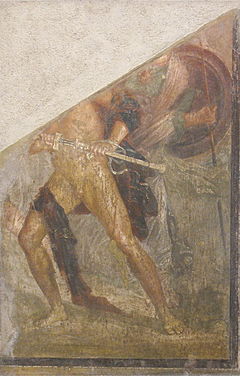
| via Wikimedia Commons |
Q: In your translation Achilles responds, “Don’t talk to me of agreements, you son of a bitch,” whereas Fagles’s Achilles says, “Hector, stop! You unforgiveable, you . . . don’t talk to me of pacts.”
A: Here’s my attitude: the English has to be alive. It has to be something that someone could believably say, so it has to be part of a living language. And it has to have the kind of emotional power behind it that I feel when reading the Greek. Here is Achilles expressing his heartbreak and contempt and intense hatred at the enemy who has killed his beloved friend—if it doesn’t have the emotional power behind it, it means nothing. There are only a few expressions in English these days that convey that kind of intense contempt—“son of a bitch” is about as good as it gets.
This is something I'm always very aware of in the classroom. Conveying the emotional power and the liveliness of the classics has an urgency for me that it does not for my older and more secure colleagues. Oftentimes trying to convey this is a great pleasure. Other times, I feel that my lack of traditional professorial gravitas (gender, stuffiness, elbow patches) mean that I have to keep the excitement high all the time, and it's exhausting. A professor who doesn't look like the stereotypical thinker of deep thoughts must therefore be 'cool' and a buddy, right?




 is beautiful and accessible and has a reasonably informative introduction.
 , whose name means "girl," is the best known Greek woman poet after Sappho. She lived in either the 6th or 3nd century BC. There is an old story that she tutored the 6th century poet Pindar, who wrote poems to celebrate victorious athletes. When she afterwards defeated him in a poetic competition, he called her a "sow." But this story may have been invented, since her poetry uses spellings for Greek words that were current in the 3rd century. Her works, which do not survive apart from fragments on papyrus, dealt with local legends and the gods of her native mountains and rivers.