In high school I was both unpopular and an underachieving student (my parents were thrilled :)) I would ride my bike around daydreaming, and once I passed a tiny, scholarly-looking bookstore about 4 miles from my house. I walked in and bought Christine de Pizan's The Book of the City of Ladies.
Yesterday I pulled it off the shelf and was fascinated anew by its blend of scholarship and surprisingly assertive proto-feminism. de Pizan, daughter of a Venetian court astronomer, married at 15 and was widowed (with three children!) at 25. She turned to writing to support herself, her children, a niece and her aged mother.
The Book of the City of Ladies describes her plain astonishment at the poor opinion of women put forth by intellectuals in her day. She strongly feels this is contradicted by common sense, if nothing else (I am at Starbuck so I can't provide the direct quote). Much of the rest of the book is taken up with examples of virtuous women from classical antiquity and the Bible. I certainly envy her the cheerful confidence with which she discusses her examples. (I suppose in the 14th century it was a lot easier to be sure you had consulted all available sources! Those were the days ...)
Another thing I enjoy about her book is the anecdote at the beginning, which is strikingly reminiscent of a modern personal essay. I can quote that bit from the text sample at Amazon: "One day I was sitting in my study surrounded by books of different kinds, for it has long been my habit to engage in the pursuit of knowledge. My mind had grown weary as I had spent the day struggling with the weighty tomes of various authors whom I had been studying for some time."* I assume most of my readers know what that's like.
* tr. Rosalind Brown-Grant
Pin It
Friday, September 23, 2011
Christine de Pizan
Labels:
Greek literature,
Latin literature,
medieval,
middle ages
Wednesday, September 21, 2011
I need to be tougher
So, I have been letting my Latin students do corrections on quizzes (for half their missing points) if their original grade is below a B. Self-correction can be a good learning experience, and I don't want this class to continue on to intermediate Latin in a state of cluelessness.
Despite the great generosity of this policy, today I started to see grade creep. People were handing in quizzes on which they originally received Bs, with their self-corrections attached.
Background: I tend to be afraid of ticking students off. As a woman I am keenly aware of the sexism of student evaluations. I also had my first job at a small liberal arts college where I went in unaware of the amount of hand-holding I was expected to do. I also had two aggressive older colleagues constantly breathing down my neck (to the point of quizzing students at department gatherings oh-so-subtly about the quality of my classes).
But. Self-corrections are supposed to be about learning, not grade-grubbing. So my new policy is that they may be done by anyone gets below a 60. And of course, test and exam grades are (and have always been) immutable.
The dance between "student-friendly" and ridiculous pushover is indeed a subtle one. Pin It
Despite the great generosity of this policy, today I started to see grade creep. People were handing in quizzes on which they originally received Bs, with their self-corrections attached.
Background: I tend to be afraid of ticking students off. As a woman I am keenly aware of the sexism of student evaluations. I also had my first job at a small liberal arts college where I went in unaware of the amount of hand-holding I was expected to do. I also had two aggressive older colleagues constantly breathing down my neck (to the point of quizzing students at department gatherings oh-so-subtly about the quality of my classes).
But. Self-corrections are supposed to be about learning, not grade-grubbing. So my new policy is that they may be done by anyone gets below a 60. And of course, test and exam grades are (and have always been) immutable.
The dance between "student-friendly" and ridiculous pushover is indeed a subtle one. Pin It
Monday, September 19, 2011
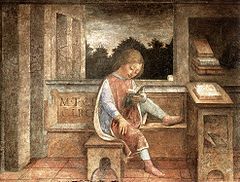
"A letter does not blush"
See a beautiful notecard (alternate version) based on this quote in my Zazzle shop:
To Lucceius, Arpinum April 56 BC
![]() |
| Vincenzo Foppa, The Young Cicero Reading |
Also available (t-shirts and mugs):
Meles mellis non curat. ("Honey badger don't care")*
Id quod mater tua dixit non est. ("That's not what your mother said")
Quis pater tuus? ("Who's your daddy?")
O tempora! O mores! ("Shame on the age and its principles!")
Venefica aetatis meae illustratissima sum ("I'm the brightest witch of my age")
*Available in several versions.
I love David Bamber as Cicero:
Pin It
Labels:
funny Latin t-shirt,
latin gifts,
Latin language,
Rome HBO
Friday, September 16, 2011
Roman art proves fish have gotten smaller
Under the influence of these mosaics experts have raised grouper in shallow pools and seen them grow much larger than the wild fish. Roman art being used by scientists totally delights me. I guess it is further proof of how much grad school narrows your focus, that such a thing had never occurred to me before. Thanks blogging! Pin It
Thursday, September 15, 2011
What makes a good historical novel?
As a voracious reader of historical fiction, sometimes I wonder which is better: a novel about a famous person or a novel about a random person living in times of great upheaval? My favorite medieval fiction is split about evenly: Elizabeth Chadwick's and Philippa Gregory's novels usually revolve around a historically known main character, whereas the Outlander Novels and the works of Ellis Peters and Norah Lofts often don't.
If you are writing about a known person you are stuck with their often shockingly vivid flaws. Philippa Gregory has been criticized for the negative qualities she attributes to Anne Boleyn in The Other Boleyn Girl, although I believe her Anne is still sympathetic, and Mary is her real heroine anyway. But I have trouble wrapping my head around the idea of a "made-up person who encounters famous people/events" novel. It does involve working with the imagination on a different level, and sometimes you end up with a silly "Oh my goodness! I, a simple milkmaid, just happened to trip over George Washington!" type of thing. Pin It
Labels:
historical fiction,
historical novels,
medieval,
middle ages
Wednesday, September 14, 2011
Dobby vs. Pericles: A Comparison
Yes, that Dobby (tongue firmly in cheek):
Pericles
-Defended freedom in the funeral oration after opening a can of whup-ass on Samos and Byzantium
-Unsuccessfully tried to save his friend Phidias from imprisonment
-Died of an unexpected plague
Dobby
-Declared he is a free elf before opening a can of whup-ass on Bellatrix Lestrange
-Unsuccessfully tried to save his hero Harry Potter from returning to school
-Died of an unexpected dagger wound
Pin It
Pericles
-Defended freedom in the funeral oration after opening a can of whup-ass on Samos and Byzantium
-Unsuccessfully tried to save his friend Phidias from imprisonment
-Died of an unexpected plague
Dobby
-Declared he is a free elf before opening a can of whup-ass on Bellatrix Lestrange
-Unsuccessfully tried to save his hero Harry Potter from returning to school
-Died of an unexpected dagger wound
Pin It
Tuesday, September 13, 2011
Wonders of the medieval world
Check out Salon.com's slideshow, with commentary, of beautiful and significant things that started in the middle ages: elaborate geometric wall art, universities, illuminated manuscripts, advances in engineering, and more.
Pin It
Subscribe to:
Posts (Atom)