Monday, October 31, 2011

Happy Halloween

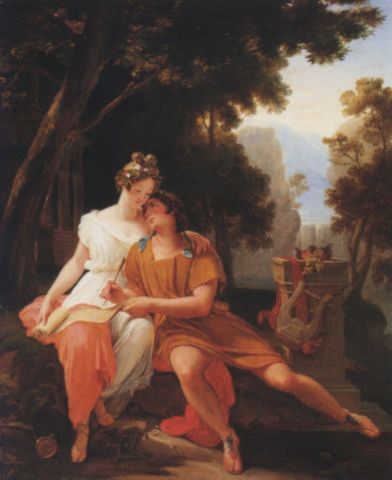
Propertius and Cynthia by Vinchon,
via Wikimedia Commons

Sunt aliquid Manes: letum non omnia finit, 
  luridaque euictos effugit umbra rogos.
Cynthia namque meo uisa est incumbere fulcro, 
  murmur ad extremae nuper humata uiae, 
cum mihi somnus ab exsequiis penderet amoris,
  et quererer lecti frigida regna mei. 

There are ghosts: death does not finish everything,
a pale shade flees from the conquered pyre.
For Cynthia I saw leaning over my bed,
Recently buried beside the noise of the outer road,
When sleep hung over me after love's final rites,
And I complained of the cold kingdom of my bed.

-Propertius IV.7
Pin It

Wednesday, October 26, 2011

Hello Greek, I've missed you

I have an article that's almost ready to go (they always are, aren't they?), except for some Greek texts that need to be formatted in some particularly picky and annoying ways. I was reading one over just now, expecting to continue to be bored and annoyed, but instead the sound of the Greek gave me my first bit of Classics-related joy in several days.

I thought, "I've missed you, Greek."

I have thought before that the sense of professional disconnection I sometimes experience relates to spending 90% of my time teaching a language I have little intellectual interest in, namely Latin. That seems harsh, and I tend to speak hyperbolically about these things. I'm happy that Latin has paid my bills for the last half-decade. When I hear something interesting about Latin I think, "oh, that's nice," whereas I love the sound of Greek, its mysterious and fluid sound-changes, and its literature whose original and profoundly situational performance contexts we can often only guess at.

I guess I have Steve Jobs to thank, as corny as that is. I used to spend the entire early morning preparing for my Latin class, and then I read something he said, about if this was the last day of your life, would you want to spend it the way you were planning to do?

And I thought, I'm done neglecting my first and best-loved foreign language in favor of what (right now) pays the bills.
Pin It
Tuesday, October 25, 2011

Does Amazon make books better or worse?

The NYT debated whether their burgeoning publishing arm hurts or helps publishers this morning. It might be simplistic, but I'm more interested in the above question than whether they are helping to drive a possibly-on-the-verge-of-irrelevant industry out of business.

I'm not sure, actually. As a confessed historical fiction addict, I've downloaded a handful of novels self-published on Kindle, and I haven't necessarily been wild about them. I'm more of a fan of established authors like Diana Gabaldon, Philippa Gregory and Elizabeth Chadwick.

But if I read a fabulous book, I certainly wouldn't care who had published it. As Michael Wolf writes:

Traditional publishers, unfortunately, don’t have a relationship with the reader -- or if they do, it’s extremely tenuous. Ask most consumers what publishers their favorite authors are aligned with, and 9 out of 10 couldn’t tell you. If you don’t have a relationship, you can be cut out, and this is what Amazon knows and what writers are learning.
Pin It

Friday, October 21, 2011

Stephen Mitchell's Iliad and the college classroom

I enjoyed Maclean.ca's interview with Stephen Mitchell, author of a new and apparently very striking translation of the Iliad. The line he translates using "son of a bitch" has come up frequently in coverage of the volume's release. His explanation in this interview resonated with me:
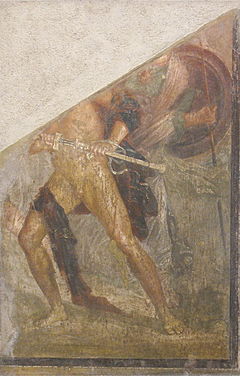
via Wikimedia Commons
Q: In your translation Achilles responds, “Don’t talk to me of agreements, you son of a bitch,” whereas Fagles’s Achilles says, “Hector, stop! You unforgiveable, you . . . don’t talk to me of pacts.”
A: Here’s my attitude: the English has to be alive. It has to be something that someone could believably say, so it has to be part of a living language. And it has to have the kind of emotional power behind it that I feel when reading the Greek. Here is Achilles expressing his heartbreak and contempt and intense hatred at the enemy who has killed his beloved friend—if it doesn’t have the emotional power behind it, it means nothing. There are only a few expressions in English these days that convey that kind of intense contempt—“son of a bitch” is about as good as it gets.
This is something I'm always very aware of in the classroom. Conveying the emotional power and the liveliness of the classics has an urgency for me that it does not for my older and more secure colleagues. Oftentimes trying to convey this is a great pleasure. Other times, I feel that my lack of traditional professorial gravitas (gender, stuffiness, elbow patches) mean that I have to keep the excitement high all the time, and it's exhausting. A professor who doesn't look like the stereotypical thinker of deep thoughts must therefore be 'cool' and a buddy, right?
Pin It

Wednesday, October 19, 2011

Home internet is back!

My home internet is back, so I look forward to resuming posting. Today I finished a book review (the scholarly kind, not the blogging kind) that I've been meaning to do for a few days. Tomorrow I play. Pin It

Monday, October 17, 2011

"Grant me chastity and continence, but not yet"

A new Classics Daily t-shirt, based on the prayer of St. Augustine: da mihi castitatem et continentiam, sed noli modo.

Previous shirts/gifts:


Pin It

Friday, October 14, 2011

The Iliad and 'Drive'

While my mom was here my husband and I got to go to the movies (twice! by ourselves!). Moneyball was boring, although I could see how it got its good movie vibes: there was no cheap emotion, and all the scenes advanced the plot. It maybe could have used a little cheap emotion. But I digress.

Drive was haunting. Looking at its Wikipedia entry, I see that it was intended as a modern fairy tale. But what it really reminds me of is Homer's Iliad. Thinking about my novel, I've been trying to imagine marriage relationships in Homeric Greece. Drive recreated in a modern setting that vast divide between men's and women's lives that is especially characteristic of the Iliad.


The scene that epitomizes this, of course, is the elevator sequence, where the Driver kisses Irene for the first and last time, moments before he kills the third passenger in the elevator. He moves her aside, kisses her with his full attention, and then throws himself whole-heartedly into murdering the mob assassin riding the elevator with them.


Throughout the movie, there is emphasis on Irene's separation from the violence and killing. Albert Brooks tells the Driver that if he gives back the money, "the girl is off the map." The violence and killing itself resembles violent incidents in the Iliad: we are given enough background to feel pity, but at the same time the murders are carried out quite dispassionately.


I'm not saying that the movie 'alludes' to the Iliad. It seems to express some kind of man-woman drama similar to that which inspired Homer's poem.


Pin It